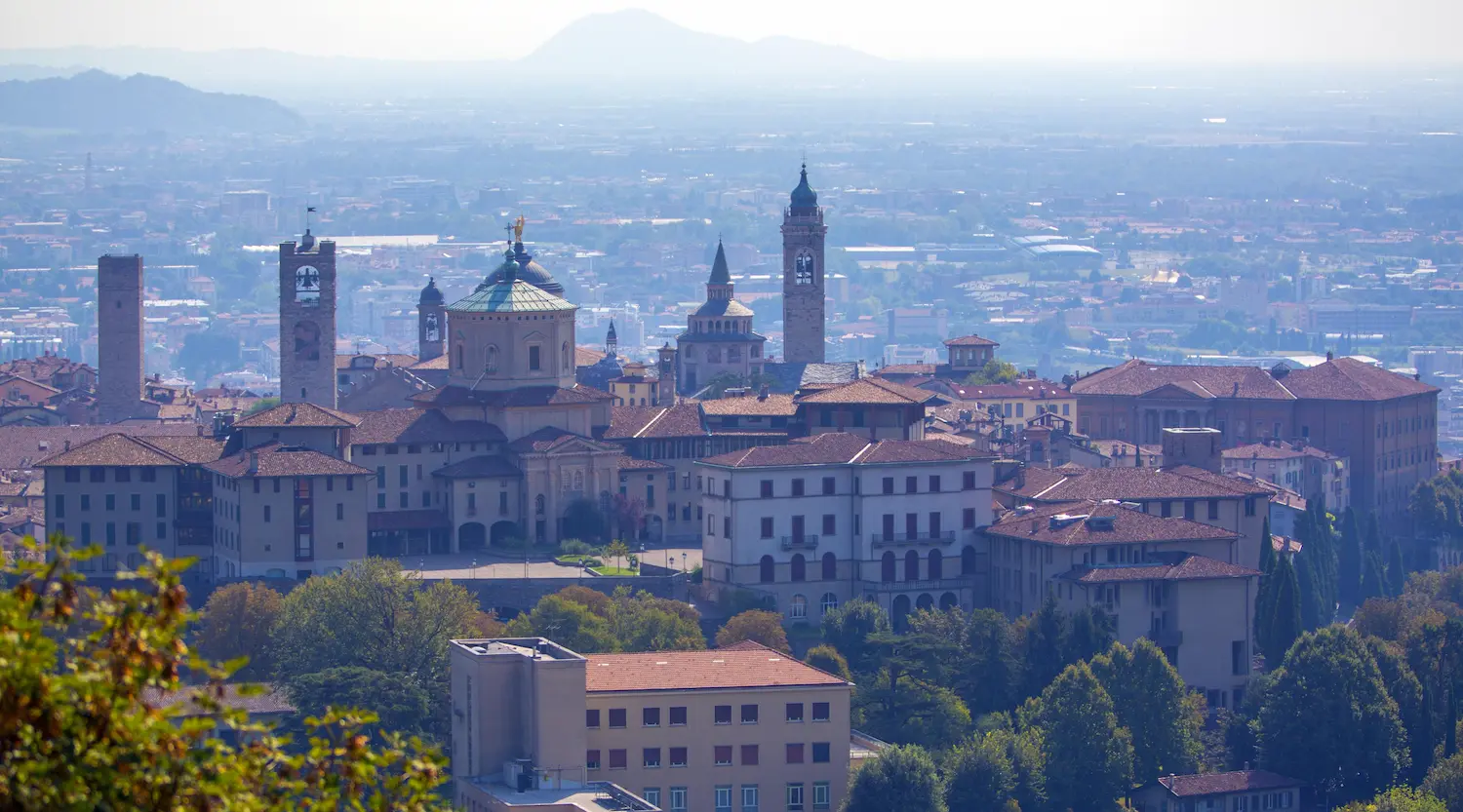
Less than an hour from Milan by train — or 15 minutes from Orio al Serio airport by bus — Bergamo's medieval Città Alta is one of the most rewarding day trips in northern Italy. Cobbled lanes, Venetian walls, extraordinary food, and views to the Alps.
Last verified: April 2026. Prices and transport details change regularly. Always check official sources before travelling.
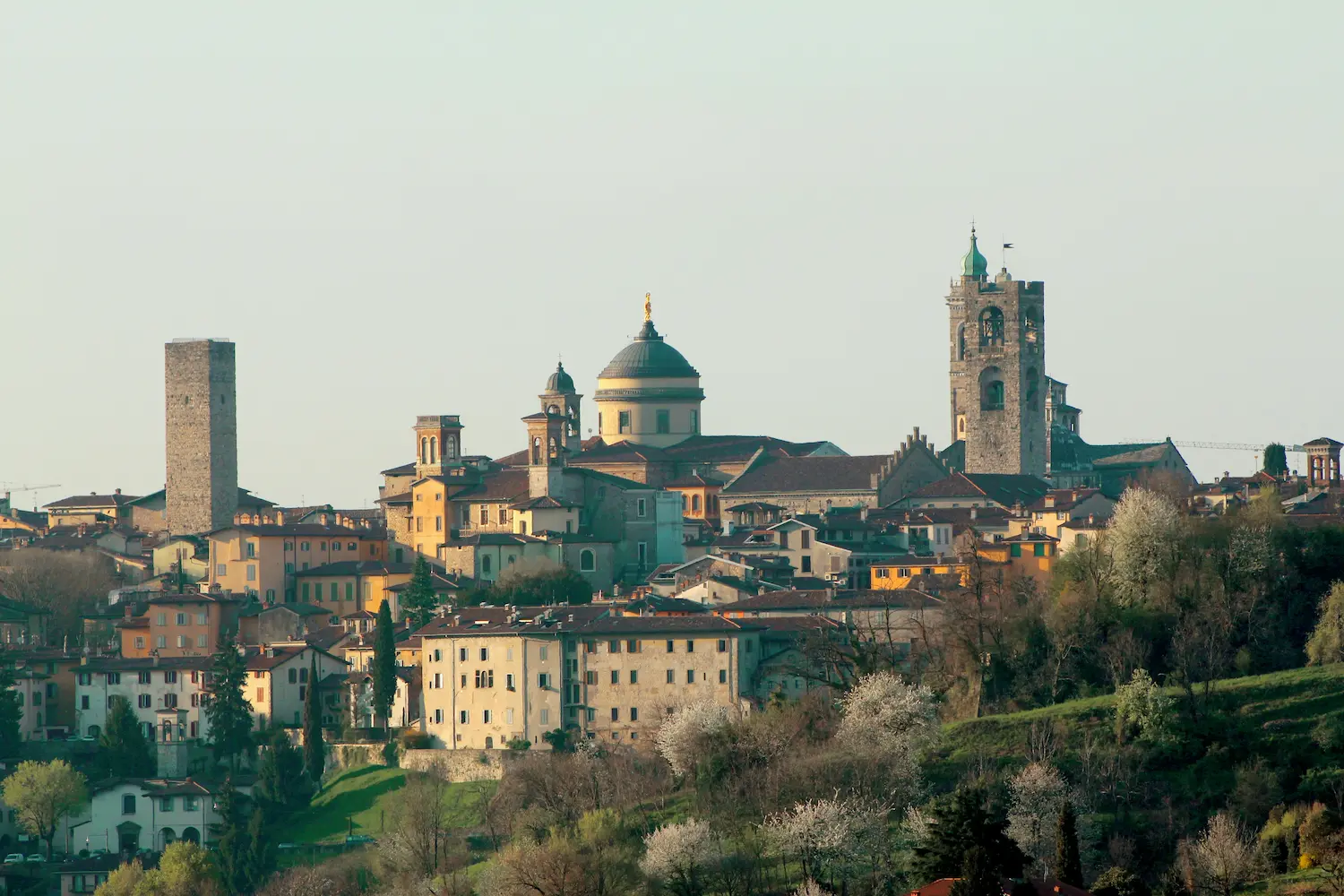
Bergamo is one of those places that stops you in your tracks — sometimes literally. Step out of the funicular at the top of the hill and you're inside a medieval walled city that feels entirely detached from the modern world below.
Tickets to get there cost around €6. It's also, conveniently, home to Milan's low-cost airport — which means Bergamo works just as well as a half-day stopover before a flight or after landing as it does as a standalone trip.
Here's everything you need to plan a day trip to Bergamo from Milan by train — or to make the most of a few hours if you're passing through Orio al Serio (the other name for Bergamo Airport). If you're new to train travel in Italy, our guide to travelling Italy by train covers everything you need to know.
Bergamo day trip — at a glance
| 🚆 Journey time from Milan | 48–50 minutes from Milano Centrale |
| 🎟 Ticket price | From approx. €6 one way |
| 🕐 Time needed | Half day minimum; full day recommended |
| 🚡 Getting to Città Alta | Funicular from Città Bassa (approx. €1.70) or Bus 1 direct |
| ✈️ Airport connection | ATB bus from Orio al Serio (BGY) — 15 mins to station |
| 📅 Best time to visit | Spring and autumn; summer evenings are magical |
| 🧀 Don't miss | Casoncelli, polenta taragna, stracciatella gelato at La Marianna |
Getting to Bergamo from Milan by Train
The train from Milano Centrale to Bergamo runs roughly every hour throughout the day, operated by Trenord. The journey takes around 48–50 minutes and is direct — no changes required. Tickets start from around €6 and can be bought at the machines in the train station, on the Trenitalia app, or on Trainline. No advance booking needed; these are regional trains and seats don't sell out. For a full explanation of how Italian train tickets work, see our Italy train network guide.
Note that some services depart from Milano Porta Garibaldi rather than Centrale and take 1 hour 5 mins— always check your specific train before you travel. Both stations are straightforward to reach on Milan's metro.
Bergamo station sits in the lower city, Città Bassa. From here you have two options for reaching the medieval upper town, Città Alta.
Getting Up to Città Alta: Funicular or Bus?
This is the question most guides skip over. You have two options, and they give you different experiences.
Option 1: The Funicular
The Funicolare Città Alta departs from Viale Vittorio Emanuele II — a 15–20 minute walk from the station, or a short ride on Bus 1. It climbs steeply to Piazza Mercato delle Scarpe in the heart of Città Alta, taking just a few minutes. The ride itself is part of the experience — you get your first proper view over Città Bassa as you ascend, and arriving directly into the old town feels like stepping through a curtain.
A single ticket costs around €1.70. A day ticket (approximately €4–5) covers unlimited travel on all ATB buses and both funiculars — well worth it if you plan to explore freely.
Option 2: Bus 1 Direct to Città Alta
Bus 1 runs from the train station all the way up through Città Bassa, past the funicular station, and continues to the far end of Città Alta at Colle Aperto. If you want to start your visit from the quieter western end of the old town rather than the busier funicular entrance, this is the better option. It also means you can take the funicular on the way back down. The bus ticket costs the same: €1.70.
My recommendation: take Bus 1 up to Colle Aperto, walk the length of Città Alta from west to east, and descend by funicular. You see the whole town in the best order and you won't need to retrace your steps.
There is also a second funicular, the Funicolare San Vigilio, which runs from the top of Città Alta up to the even higher San Vigilio hill. More on that below.
If You're Flying via Orio al Serio (BGY)
Bergamo's airport — officially Milan Bergamo Airport, Orio al Serio — is one of Europe's busiest low-cost hubs. If you're flying in or out on Ryanair or another low-cost carrier, Bergamo makes a perfect half-day stopover before your flight or after landing.
The ATB Airport Bus (an extension of Line 1) connects the airport directly to Bergamo city centre, running every 20–25 minutes. The journey to the train station takes around 15 minutes.
Crucially: a single airport bus ticket (approx. €3 for a 90-minute ticket) covers not just the bus but onward travel on all ATB buses and the funicular within the ticket's validity window. So you can step off your flight, buy one ticket at the machine outside arrivals, and use it all the way to Città Alta without buying anything else.
You can buy tickets:
- At the machine directly outside the arrivals terminal
- On the ATB Mobile app (available on iOS and Android)
- On board the bus
A 24-hour ticket (approximately €8.50 including the airport journey, or €4-5 if you are travelling around the town) is the best value if you're spending more time in the city, as it covers all buses and both funiculars for the full day.
Using Bergamo as a stopover: if your flight is in the evening, arriving into BGY in the morning gives you a comfortable half day in Città Alta before heading back to the airport. Allow at least 45 minutes to get from the city centre back to the terminal.
What to See in Bergamo's Città Alta
Città Alta is made for wandering. The walled upper town is compact — you can walk from one end to the other in about 20 minutes — but it rewards a slower pace. Here are the highlights worth seeking out.
Piazza Vecchia
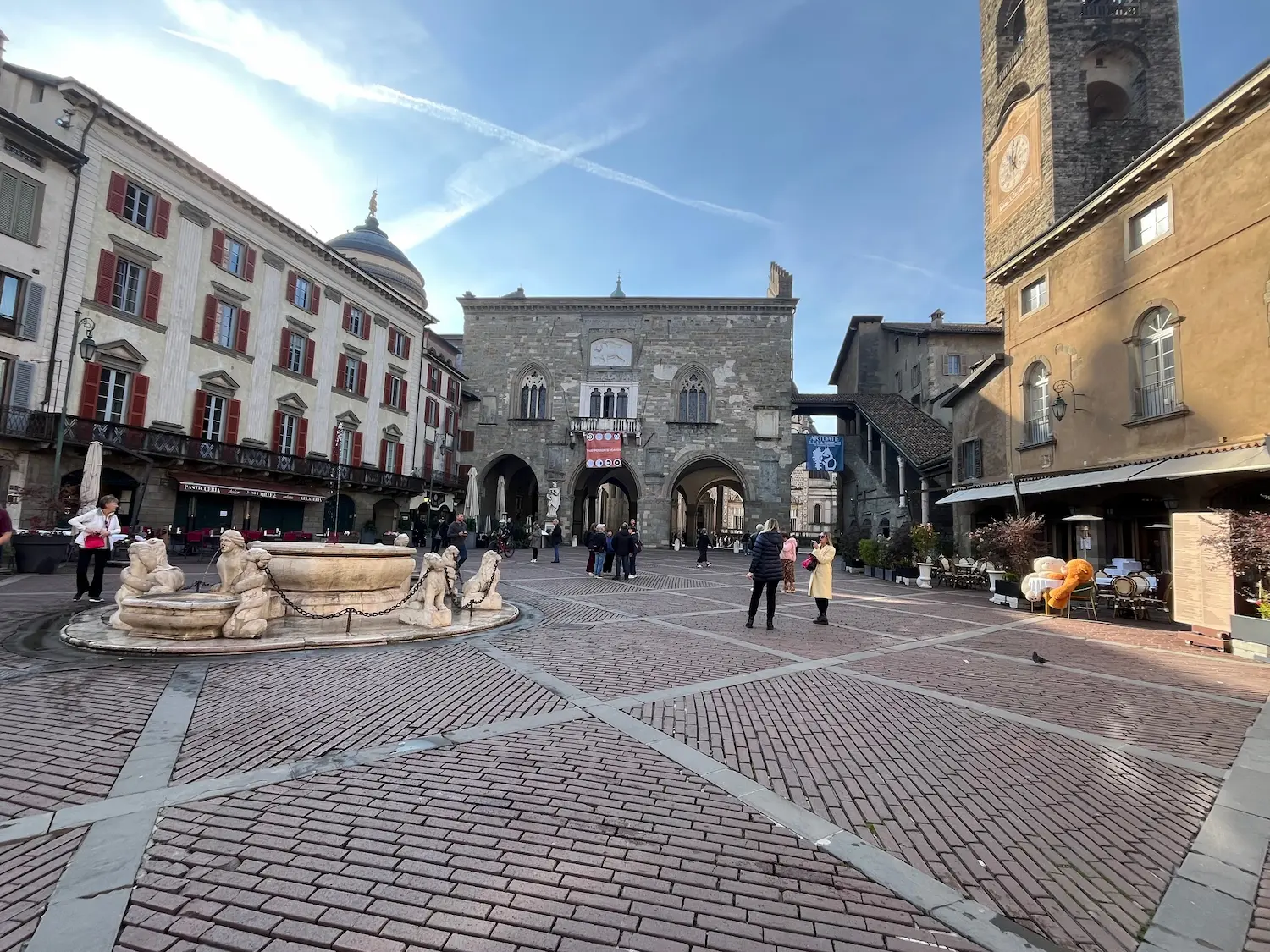
The heart of Città Alta and one of the finest squares in Lombardy. The Palazzo della Ragione (the old law court, dating to the 12th century) dominates one side; the Biblioteca Civica Angelo Mai, a former Augustinian convent, the other. In the centre, the Contarini fountain. Le Corbusier called it the most beautiful square in Europe — a claim that feels less absurd the longer you sit there.
The Torre del Campanone rises above the square. Every evening at 10pm its bell chimes 100 times, an echo of the old city curfew when the gates would close. You can climb the tower for views over Città Alta and out across the plain.
The Venetian Walls
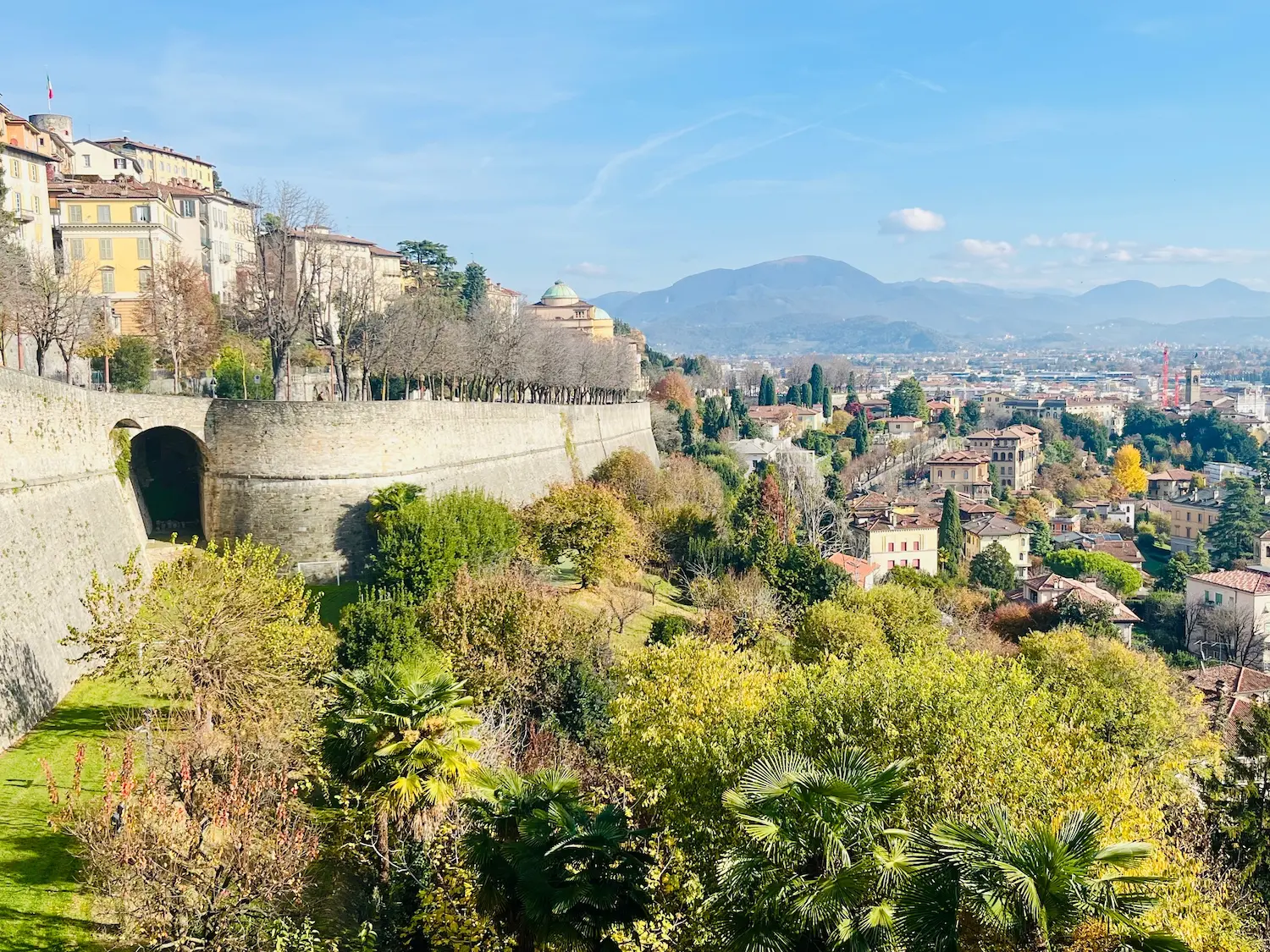
Città Alta's UNESCO-listed Venetian walls were built between 1561 and 1599, when Bergamo was the westernmost outpost of the Venetian Republic. They stretch for nearly 6km around the upper city — and the walk along the top of them is one of the best things you can do here.
Head to the southern walls to see the Città Bassa spread below, the flat Po Valley extending south, and on a clear day the unmistakable skyline of Milan's skyscrapers on the horizon.
The Duomo, Cappella Colleoni and Basilica di Santa Maria Maggiore
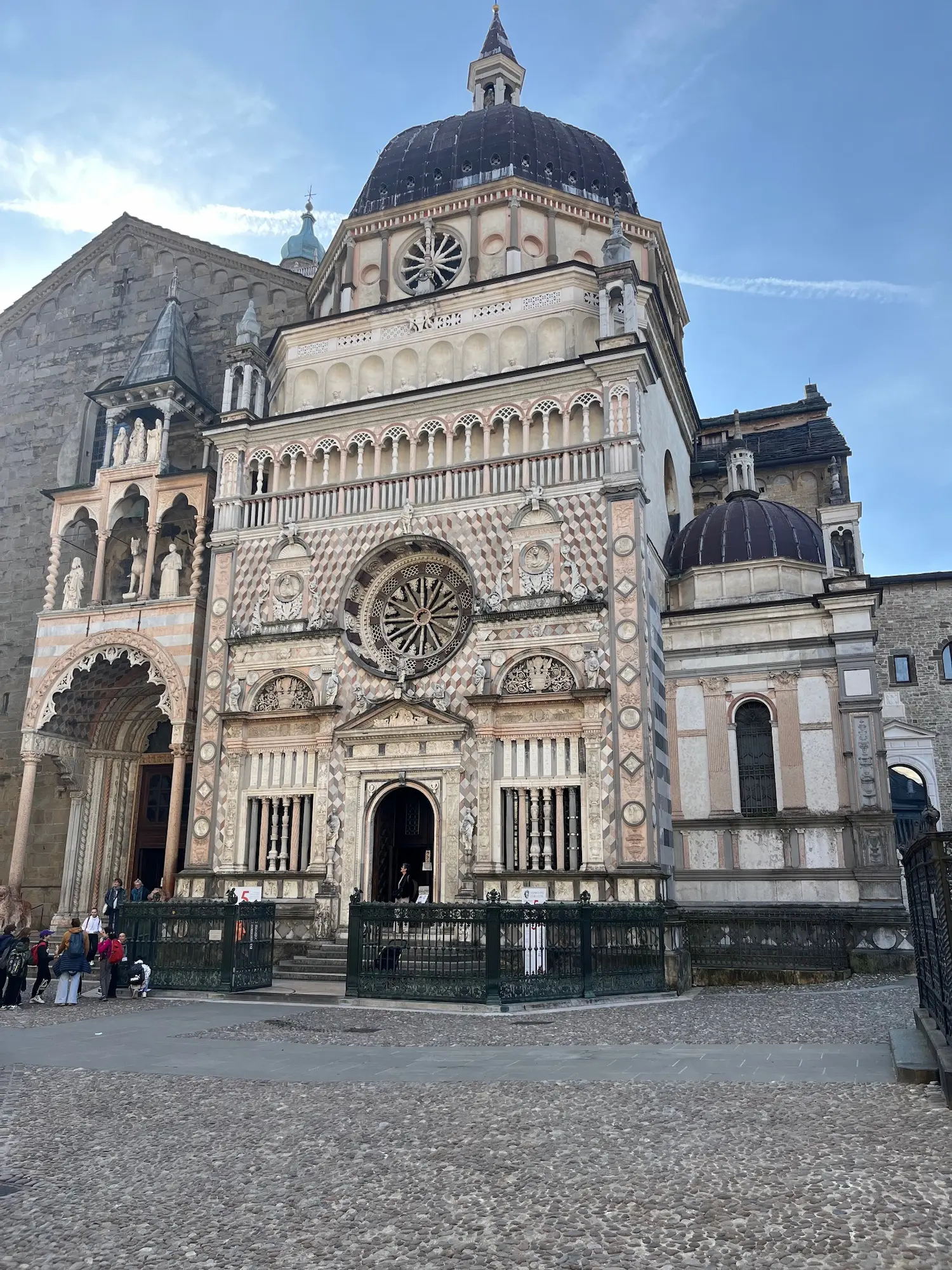
Piazza del Duomo sits a short walk from Piazza Vecchia and contains three separate buildings so tightly clustered together that they appear almost as one — worth taking time to see each of them rather than just passing through.
The Cathedral of Bergamo (Duomo di Bergamo) has a baroque interior dating largely to the 17th century — worth a look inside, but it's what stands immediately beside it that really stops you - the Cappelle Colleoni.
The Cappella Colleoni is one of the finest Renaissance buildings in Lombardy. Built between 1472 and 1476 by architect Giovanni Antonio Amadeo as the private mausoleum of Bartolomeo Colleoni — the Venetian military commander and Bergamo's most powerful native son — it was constructed by demolishing the old sacristy of the neighbouring basilica, a move that caused considerable controversy at the time. The facade is extraordinary: white, red and black polychrome marble in intricate geometric patterns, carved with sculptures and bas-reliefs that make it one of the most decorative building fronts in northern Italy. Inside, the ceiling carries frescoes by Giambattista Tiepolo, painted in 1732. Entry is free.
Directly attached to the Cappella — though a completely separate building — the Basilica di Santa Maria Maggiore began in 1137 and was rebuilt and expanded over the following centuries. The interior is overwhelming — tapestries, frescoes, gilded decoration layered across centuries. Look for the intarsia panels in the choir: inlaid wooden marquetry depicting biblical scenes in trompe l'oeil perspective, one of the most accomplished decorative features in the city.
Gaetano Donizetti — Bergamo's Famous Son
Bergamo was the birthplace of Gaetano Donizetti (1797–1848), one of the great composers of Italian opera — Lucia di Lammermoor, L'elisir d'amore and Don Pasquale are among his most celebrated works. The Museo Donizettiano in Città Alta is dedicated to his life and music, and the Teatro Donizetti in Città Bassa stages regular opera performances. If you have any interest in Italian opera, checking the programme before you visit is worth five minutes.
The Walls Walk and the View from the Edge
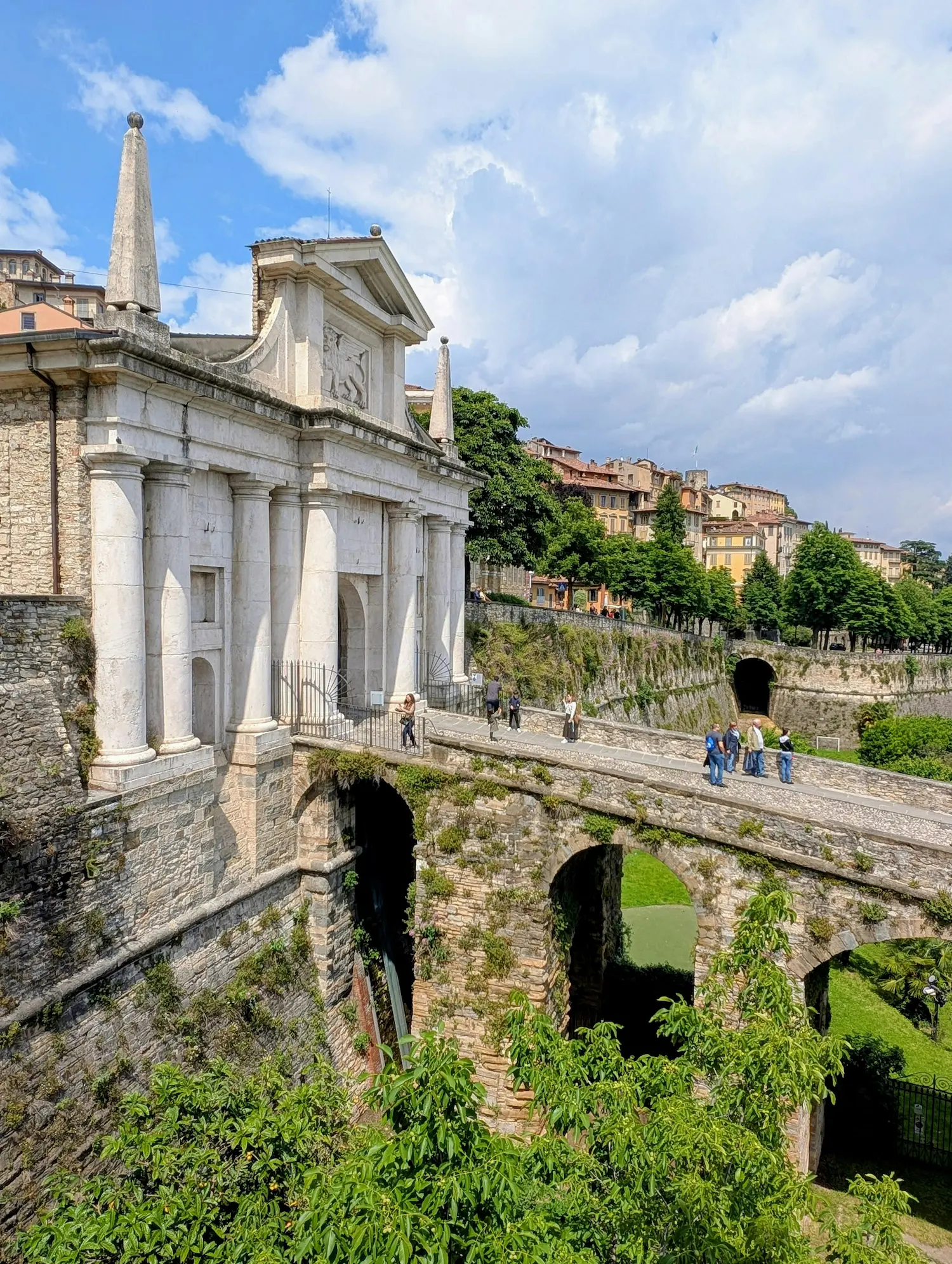
This deserves its own mention. Follow the path that runs along the inside of the walls from Porta Sant'Agostino around to Porta San Giacomo — roughly the eastern arc of the walls. The views from here down over the modern city are remarkable, and the path is surprisingly quiet even when the main streets of Città Alta are busy. It's the part of Bergamo that I remember best.
San Vigilio — The View Above the View
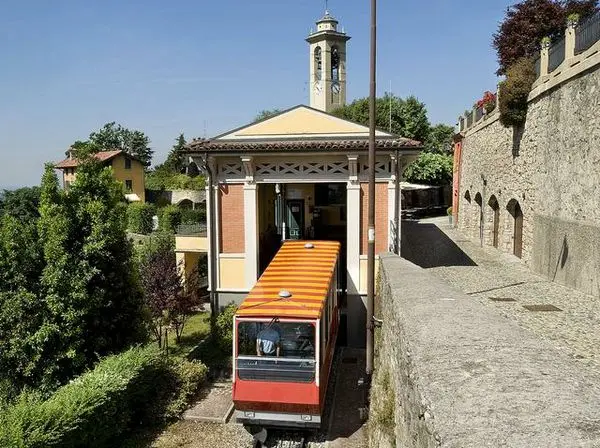
If you want to go higher still, the Funicolare San Vigilio runs from Colle Aperto (the western end of Città Alta) up to the San Vigilio hill. At the top, the ruins of a small castle and a view that takes in the whole of Città Alta, the valley, and on clear days, the Alps. It's a short ride and the same ATB ticket covers it. Best at sunset.
Food in Bergamo: What to Eat
Bergamo has a serious food culture, rooted in the mountain and peasant traditions of the surrounding Lombard hills and valleys. The cuisine is rich, filling, and surprisingly distinctive.
Casoncelli (Casonsei)

The dish Bergamo is most proud of. These are half-moon pasta parcels traditionally filled with a mix of minced meat, breadcrumbs, parmesan, raisins, and amaretti biscuits — a combination of sweet and savoury that sounds unlikely and tastes excellent. They're served with melted butter, crispy pancetta, and sage. The filling recipe varies between households and restaurants, but the butter and sage dressing is common to all types.
Polenta Taragna

Not ordinary polenta. Polenta taragna is made with a mix of cornmeal and buckwheat flour, giving it a darker colour, denser texture and earthier flavour. It's cooked with Taleggio or other local cheeses until rich and creamy, and served with mushrooms, stewed meat, or simply on its own. The name comes from the tarèl — the wooden stick used to stir it. Polentone in Piazza Mercato delle Scarpe (right at the top of the funicular) is the classic spot to try it, with a choice of toppings including wild boar, porcini, and Taleggio.
Polenta e Osei — The Dessert Version

A distinctly Bergamo confection is Polenta e Osei. The pastry shop windows of Città Alta are full of small yellow dome-shaped cakes decorated with tiny chocolate birds. These are polenta e osei — the sweet version of the savoury dish of the same name. They're made of sponge cake soaked in rum, filled with chocolate hazelnut cream, covered in marzipan, and decorated with marzipan birds. Pick one up at Nessi bakery in Città Alta.
Stracciatella Gelato

Stracciatella — vanilla gelato threaded with shards of dark chocolate — was invented in Bergamo in 1961 by Enrico Panattoni, owner of La Marianna gelateria at Colle Aperto. The story goes that he poured melted chocolate into churning fior di latte gelato; as it hit the cold mixture the chocolate hardened and broke into thin shards. The gelateria is still there and still making it. Try it at the source.
Taleggio and Local Cheeses

Taleggio — the washed-rind cheese with the pungent smell and surprisingly mild, creamy flavour — comes from the Val Taleggio in the Bergamo hills. You'll find it on almost every menu, melted into polenta, served on a tagliere (charcuterie board), or alongside local salami and cured meats. A tagliere with local Bergamo cheese and salami makes an excellent lunch.
How to Get Back to Milan — and the Airport Option
The return train from Bergamo to Milano Centrale runs with the same frequency as the outbound — roughly hourly, taking around 50 minutes. Buy your ticket at the machines in Bergamo station or on the Trenitalia or Trainline app.
If you're heading to Malpensa or another Milan airport after Bergamo, note that Milano Centrale is the main hub for airport connections. The Malpensa Express departs from Centrale and Porta Garibaldi.
If you're flying from Orio al Serio (BGY), simply take the ATB bus back from the city centre — allow 45 minutes from Città Alta to the terminal.
The stopover option in both directions:
- Arriving at BGY: take the ATB bus straight into Città Alta, spend 3–4 hours exploring, then catch the train to Milan.
- Departing from BGY: take the morning train from Milan to Bergamo, spend the day in Città Alta, and head to the airport in the late afternoon. Far better than spending the day in a departure lounge.
Frequently Asked Questions
Is Bergamo worth a day trip from Milan?
Absolutely. Bergamo's Città Alta is one of the finest medieval walled cities in northern Italy and takes less than an hour to reach from Milan by train. It's a very different experience from Milan — quieter, older, more intimate — and the combination of architecture, views and food makes it one of the most satisfying day trips in Lombardy.
How long do you need in Bergamo?
A half day (3–4 hours) is enough to cover the main highlights of Città Alta. A full day allows you to take the walls walk, ride the San Vigilio funicular, have a proper lunch and explore at a slower pace. If you're coming from the airport, 3–4 hours in the city is easily manageable before a flight.
Can I visit Bergamo if I'm flying from Orio al Serio?
Yes — and it's one of the best airport stopovers in Italy. The ATB bus connects the airport directly to the city centre in around 15 minutes, and a single ticket covers onward travel on buses and the funicular. Arriving a day early or staying a night gives you time to properly explore.
How do I get from Bergamo back to Milan airport?
If you're flying from Orio al Serio (BGY), take the ATB bus from the city centre — the journey takes around 15 minutes to the terminal. Allow 45 minutes from Città Alta including the walk to the bus stop. Buy your ticket at any ATB machine or on the ATB Mobile app. If you're flying from Malpensa, take the train from Bergamo to Milano Centrale and connect to the Malpensa Express from there.
Do I need to book the train from Milan to Bergamo in advance?
No. These are regional Trenord trains and don't require advance booking. Buy your ticket on the day at the machines in Milano Centrale, on the Trenitalia app, or on Trainline. Remember to validate your paper ticket before boarding.
What is there to do in Bergamo besides Città Alta?
Città Bassa (the lower city) has the Accademia Carrara — one of the finest art museums in Lombardy, with works by Raphael, Botticelli and Titian — and the modern art museum GAMeC opposite. The lower city is less visited by day-trippers and has a more everyday Bergamo feel. Worth an hour or two if you have the time.
What is the best food to try in Bergamo?
Don't leave without trying casoncelli (meat-filled pasta with butter, pancetta and sage), polenta taragna (buckwheat polenta with Taleggio), and stracciatella gelato at La Marianna — the gelateria where the flavour was invented in 1961.
Is the funicular ticket included in the bus ticket?
Yes — if you buy a day ticket or a multi-zone ticket valid for the urban area, it covers both ATB buses and the funicular. A single 90-minute ticket from the airport (zone 3 ticket) also covers the funicular within its validity window. Check current fares at atb.bergamo.it.
Also from Milan by train: Pavia · Oltrepò Pavese · The Bernina Express to Switzerland· Lake Como