Most Italy trips are planned the wrong way round — places first, connections second. Here's how to build a realistic car-free itinerary that actually flows.
Most people plan an Italy trip the wrong way round. They pick the places first — Rome because it's Rome, Florence for the art, Amalfi because of the photographs — and only then start looking at how to get between them. That's when the problems start. Amalfi has no train. Getting from Rome to the Amalfi Coast involves a train to Naples, a second train to Sorrento or Salerno, and then a bus along a cliff road that takes over an hour even without traffic. What looked like an easy connection on a map turns into most of a day.
This guide works the other way round. It starts with how Italy connects, and builds itineraries from there — so you end up with a trip that flows rather than one that fights itself.
The spine of Italy
Italy’s high-speed rail network is built around a strong north–south corridor. Journeys between key cities are quick and convenient: Rome to Florence takes around 1 hour 30 minutes, Florence to Bologna about 37 minutes, Bologna to Milan in 1 hour 15 mins, and Rome to Naples roughly 1 hour 15 minutes. Many popular itineraries make use of this main line, with frequent and reliable connections between Italy’s major cities. While not every destination sits directly on the high-speed route, it provides a fast and efficient backbone for travelling around the country.
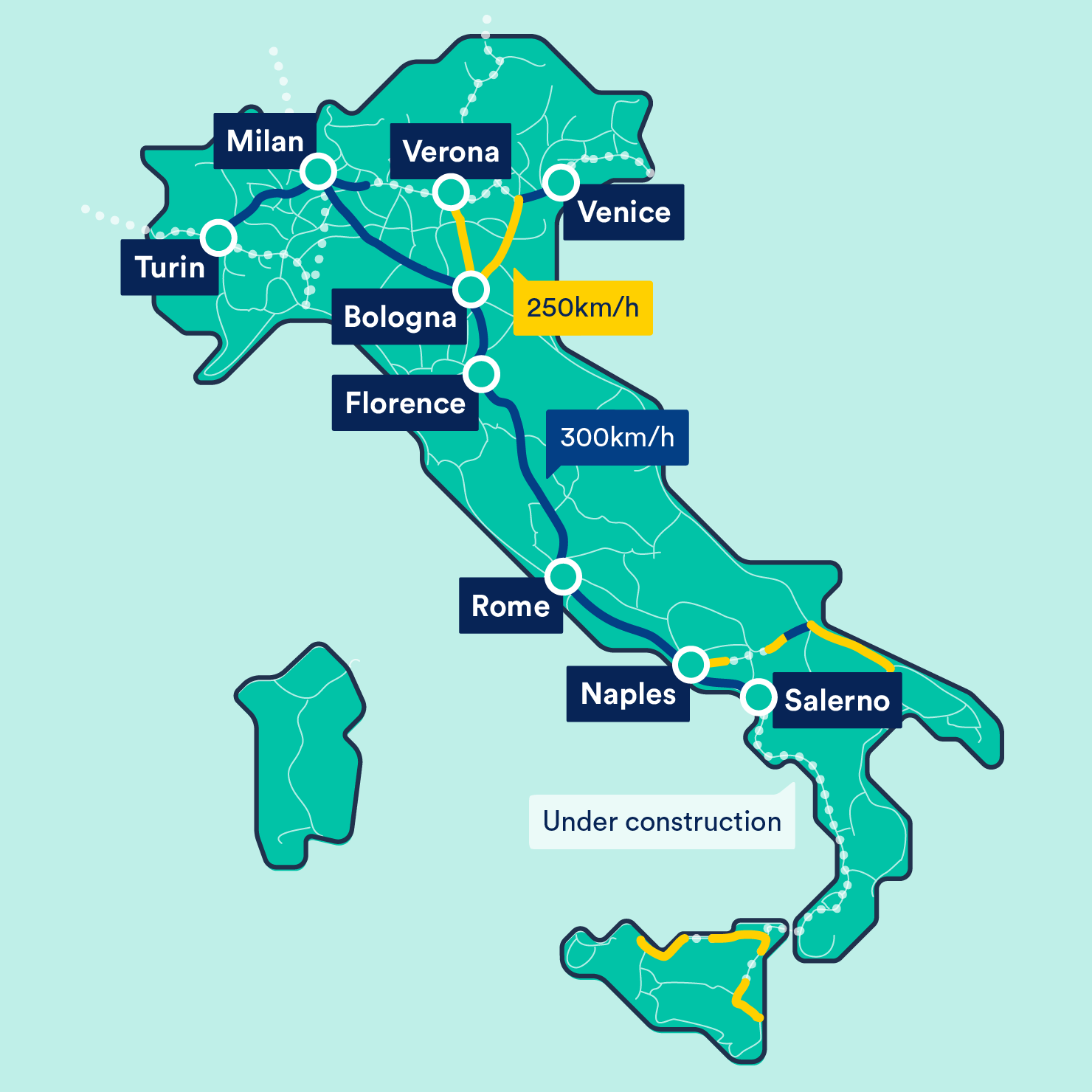
The key journey times to know:
| Journey | Time | Operator |
|---|---|---|
| Rome → Florence | 1h 30m | Trenitalia or Italo |
| Florence → Bologna | 37 mins | Trenitalia or Italo |
| Bologna → Milan | 1h 15m | Trenitalia or Italo |
| Rome → Naples | 1h 15m | Trenitalia or Italo |
| Milan → Venice | 2h 30m | Trenitalia or Italo |
| Rome → Bari (for Puglia) | 4h 30m | Trenitalia |
For a full breakdown of how to book trains, how tickets work and other train travel tips, read our guide to Italy's train network.
Which regions connect well — and which don't
This is the most important thing to understand before you start planning. Not all of Italy is equal by train.
Excellent by train: Rome, Florence, Milan, Bologna, Venice, Naples, Turin, Verona, Padua, Vicenza, Salerno, Bari.
Good but slower: Puglia (Lecce, Brindisi, Alberobello — trains exist but are regional and slower), Sicily (accessible by ferry from Naples or train via the Straits of Messina), Sardinia (internal buses and a local railway), Liguria (Genoa, La Spezia), Tuscany (Pisa, Lucca, Arezzo, Siena), Orvieto, East coast (Ancona, Pesaro, Rimini), North east (Trento, Bolzano, Trieste).
No train: Of course there are locations that are dificult to reach by bus or train. For example, the Amalfi Coast itself has no railway. You get close by train — Naples or Sorrento — and take a bus or ferry from there. It works perfectly well but takes planning. Similarly, the hill towns of Tuscany like San Gimignano and Montepulciano are bus-only from the nearest station.
The honest rule: if it's on the north-south spine or branching off a major city, trains are fast and easy. If it's on a dramatic coastline or a hilltop, there's probably a reason the railway never reached it.
Base versus moving
There are two fundamentally different ways to travel Italy by train, and they suit different people.
The base approach means staying in one city for several nights and making day trips from there. You unpack once, you're not hauling luggage every morning, and you get to know a place properly.
Florence is an excellent base for central Italy — from there you can reach Siena, Lucca, Arezzo, Pisa, Bologna, Rome and even Milan all in a single day. Rome is nearly as good, with Naples, Florence and Salerno all within easy reach. Milan is also excellent for Lake Como, Genoa, Turin, Verona, Piacenza, Parma, Modena, Bologna, Florence, Brescia, Bergamo and Pavia. Bologna, sitting between Florence and Milan also provides a great central location. Further south, Naples is an excellent location for visiting the Amalfi coast, Sorrento, Pompeii, Caserta Palace and visting the islands of Capri and Ischia. Brindisi provides a good central location in Puglia.
The moving approach means staying two or three nights in each place and travelling the spine. You see more variety, you wake up somewhere different every few days, and the journey itself becomes part of the trip. The downside is luggage — you are living out of a bag, and every travel day costs you time and energy.
Most people find a hybrid works best: two bases with a few nights each, connected by one or two longer moves. That's the structure behind all the itineraries on this site.
How many stops is realistic
This is where most Italy itineraries go wrong. One stop per week is comfortable. Two stops per week is manageable. Three or more stops per week is tiring — and you'll spend most of your holiday in transit rather than actually experiencing Italy.
A rough guide by trip length:
| Trip length | Recommended stops | Example |
|---|---|---|
| 7 days | 1 – 2 bases | Rome 4 nights + Salerno 3 nights |
| 10 days | 3 – 4 bases | Milan 4 nights + Florence 3 nights + Cinque Terre 3 nights |
| 12 days | 3 – 4 bases | Brindisi 4 + Naples 3 + Rome 3 + Florence 2 |
| 14+ days | 3 – 4 bases | Same as above with an extra night at each stop |
The temptation on a longer trip is to add more destinations. Resist it. An extra night in Florence is almost always better than a single night in Venice squeezed at the end.
Book trains before accommodation
This is the one planning rule that catches most people out. Italian high-speed trains have a fixed number of seats at each price tier. The cheapest seats sell out months in advance — not because the train is full, but because there are only a handful of seats at the lowest price. Book early and you might pay €19 for Rome to Florence. Book the week before and the same seat costs €49.
Accommodation, by contrast, is much more flexible. Hotels can usually be cancelled up to a few days before arrival. Most apartments on Airbnb have similar policies. So the sensible order is: fix your travel dates, book the trains, then book accommodation around them.
For day trips by regional train you don't need to book in advance. Regional trains have open seating and the ticket is valid for any train on the day. Only high-speed trains between major cities need advance booking.
A word on luggage
Italian trains have overhead racks and (in high-speed trains) end-of-carriage luggage areas, but they are not designed for super-large suitcases. If you can manage with a medium (max 23kg size) or smaller — particularly on older regional trains where the aisles are narrow and the luggage space is limited - it will be easier.
Where to start
If you want a ready-made itinerary rather than building your own, the routes on this site are designed around how Italy actually connects — with realistic journey times, manageable luggage days, and enough time in each place to actually see it.
The 12-day Rome to Milan itinerary is a good starting point for first-time visitors wanting to see several regions. For a shorter trip, the Rome day trips guide and Florence day trips guide cover what's reachable without moving your base.