Pompeii and Herculaneum are both within an hour of Naples by train. The same volcano buried both in 79 AD — but differently. Here's how to reach both and what to expect.
Last verified: May 2026. Opening times, prices and transport details change regularly. Always check official sources before travelling.
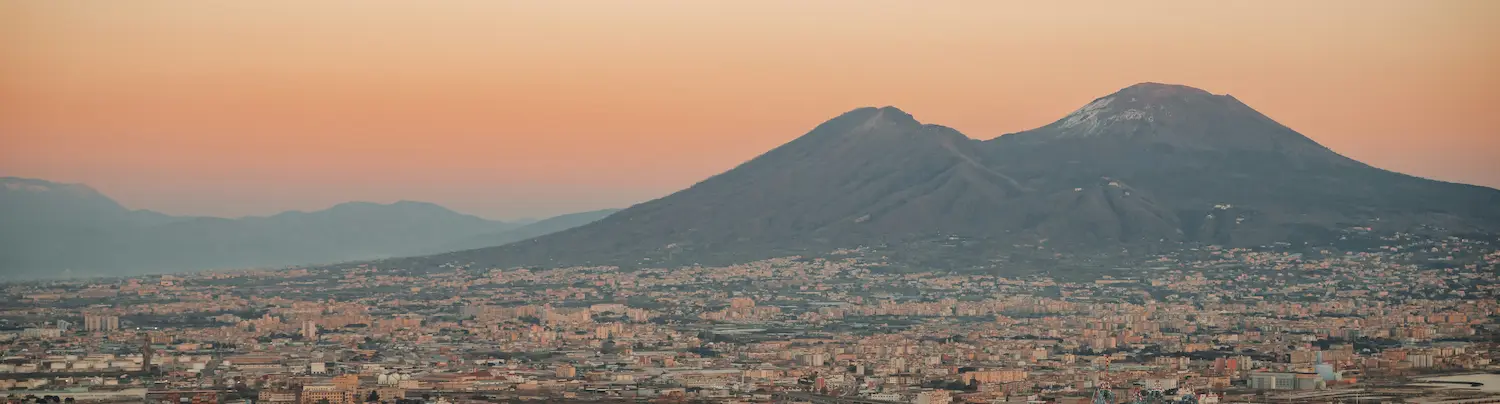
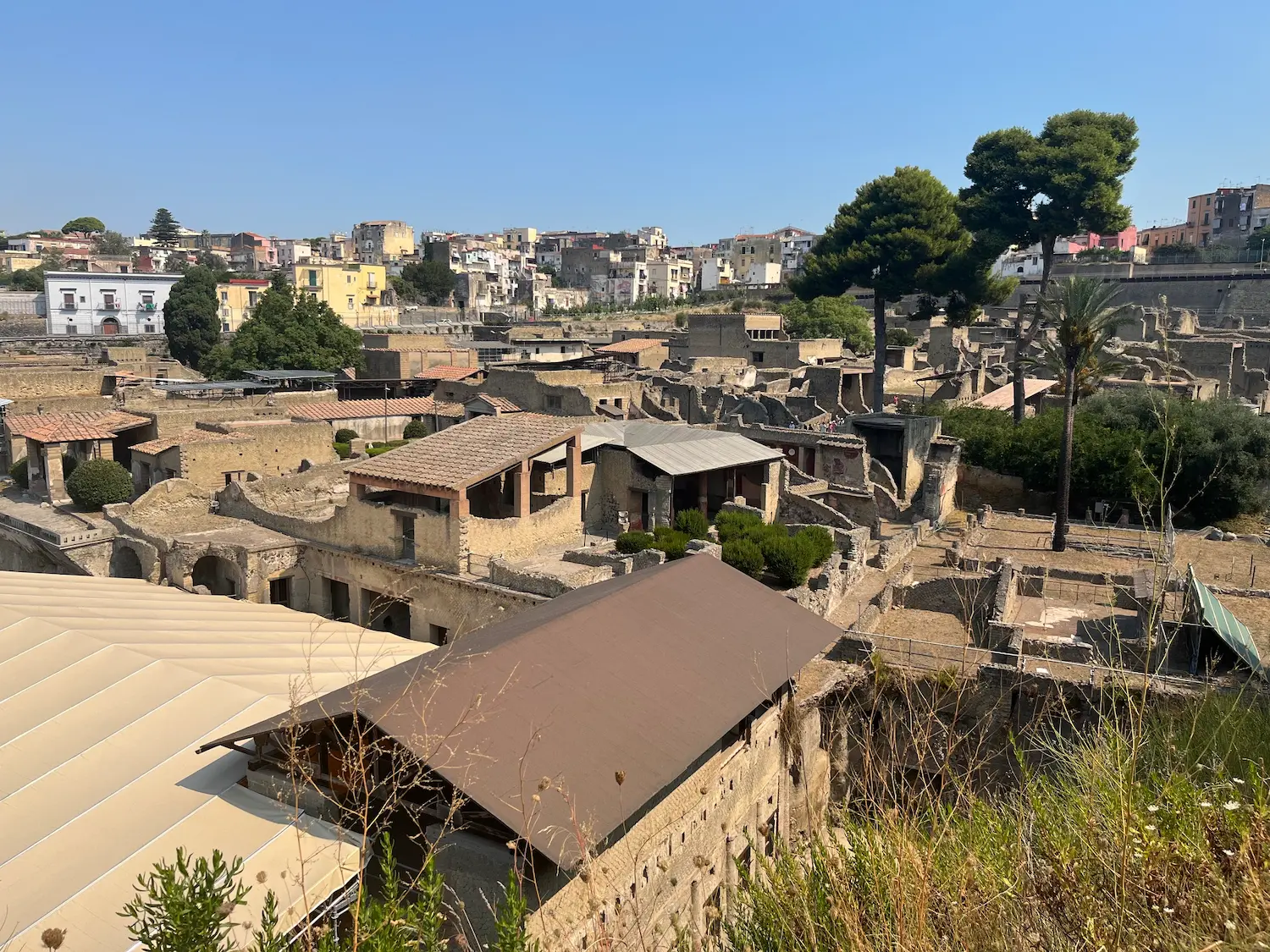
Pompeii and Herculaneum died on the same morning. The same volcano, the same eruption, a few kilometres apart — and yet they offer two completely different experiences to visit. Pompeii is sprawling and sun-baked, with Vesuvius rising dramatically behind every ruined street. Herculaneum is smaller, quieter, and sits within the modern city. It is so extraordinarily well-preserved that you find yourself staring at a wooden door or a painted fresco and struggling to process that it has been there for nearly two thousand years. One overwhelms you with scale. The other stops you in your tracks with detail. Both will stay with you.
Quick Reference
| Pompeii | Herculaneum | |
|---|---|---|
| Train station | Pompei Scavi – Villa dei Misteri | Ercolano Scavi |
| From Naples | ~35 min | ~15–20 min |
| Entry ticket price | €20 (adult) | €16 (adult) |
| Site size | ~66 hectares | ~4.5 hectares |
| Time needed | 3–5+ hours | 1.5–2.5 hours |
| Best for | Scale, drama, sweeping views | Preservation, detail, intimacy |
| Book in advance? | Yes — daily cap of 20,000 | Recommended in high season |
Why Visit Both?
They are two kilometres apart. They died on the same day. And they could not feel more different.
Pompeii was a thriving commercial city of around 11,000 people — markets, amphitheatres, bathhouses, brothels. When Vesuvius erupted on 24 August 79 AD, the city was smothered under several metres of ash and pumice. Roofs collapsed. Upper floors vanished. But the sheer scale of what survived is staggering: streets, fountains, election slogans painted on walls, loaves of bread still in their ovens.
Herculaneum was smaller and wealthier: a seaside resort town of around 5,000 people, popular with Rome's elite. It experienced the eruption very differently. Rather than ash, it was buried under a superheated pyroclastic surge of volcanic mud that reached temperatures of 500°C. That sounds worse, and for the people there it was. But for the buildings, it was almost preserving. The mud encased everything — wooden doors, painted frescoes, food on tables, even a wooden bed — before hardening into solid rock. The result is the most complete window into Roman domestic life anywhere in the world.
Both are extraordinary. Both are sad. And both will stay with you.
The History: What Happened That Morning
Pompeii
The eruption began around midday on 24 August 79 AD (though some scholars now argue it may have been October, based on finds of autumn fruits and heavy clothing). For the first several hours, Pompeii was pelted with pumice and ash falling like grey snow. Many residents fled. Those who stayed — sheltering in cellars, waiting out what they hoped was a passing event — were killed when the pyroclastic surges reached the city in the early hours of the following morning.
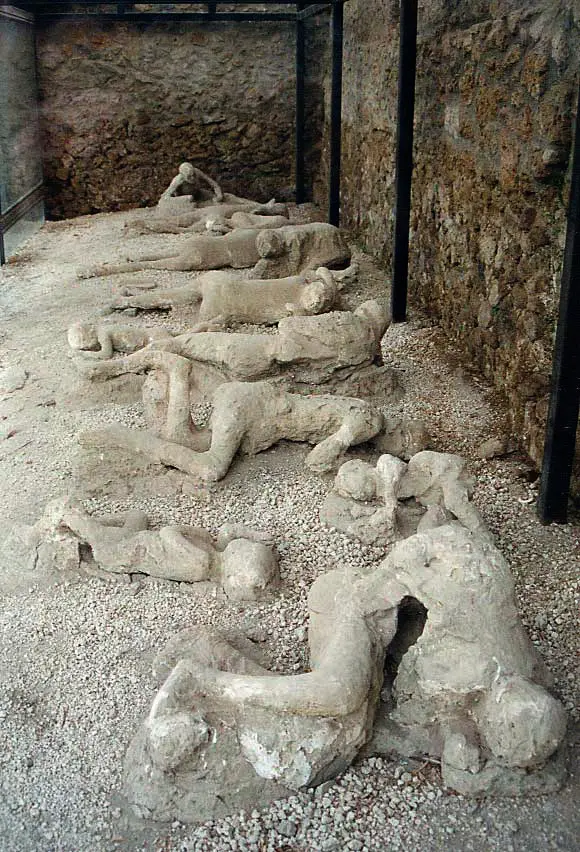
The famous plaster casts — those haunting, curled human forms you'll see in the Garden of the Fugitives and elsewhere — were made by pouring plaster into the voids left in the hardened ash where bodies had decomposed. They are among the most affecting things you'll see anywhere in Italy.
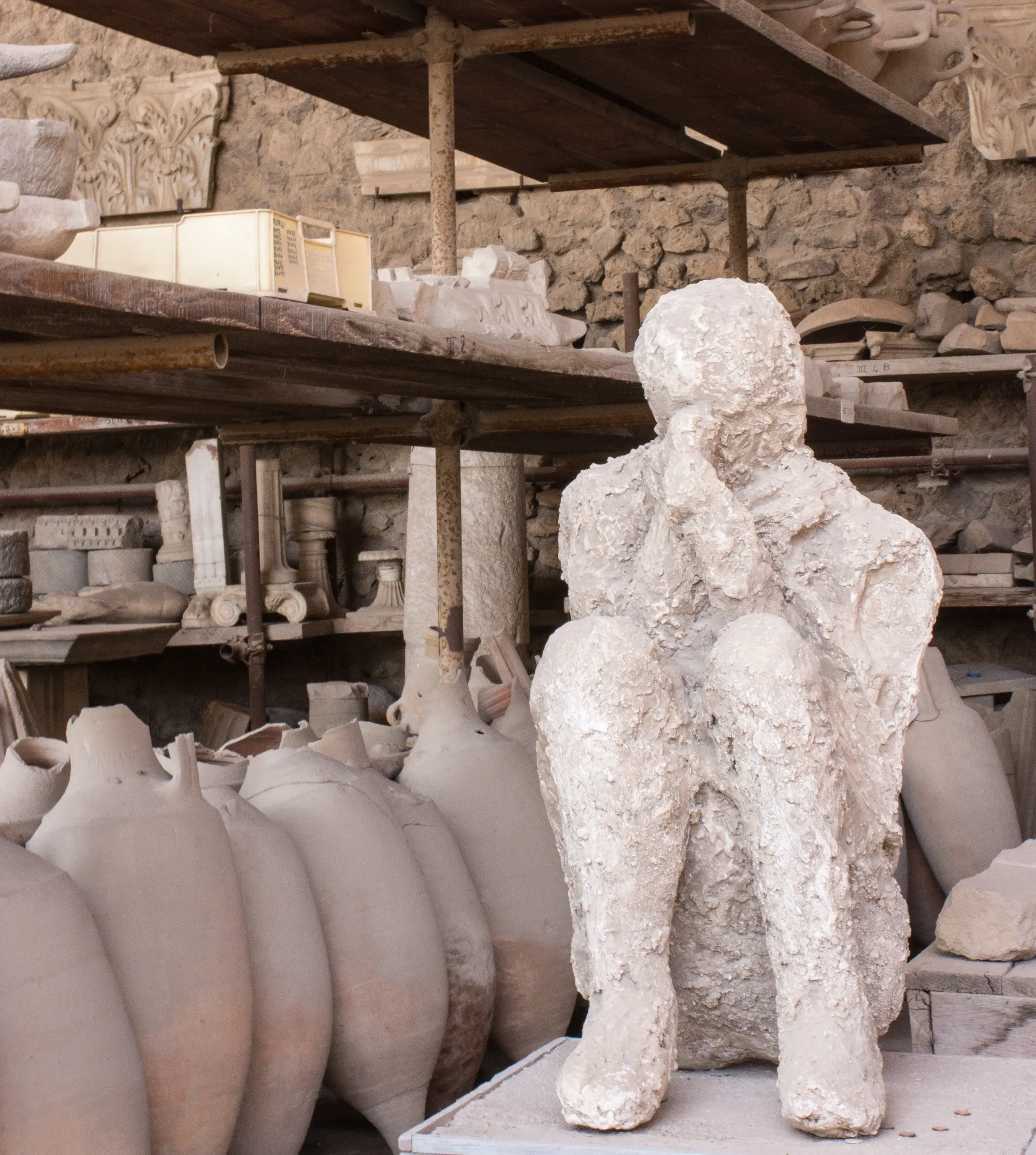
Herculaneum
Herculaneum experienced the eruption more slowly at first. Many residents appear to have evacuated early. But then came the pyroclastic surges — those fast-moving clouds of superheated gas and debris — and the town was obliterated almost instantaneously.
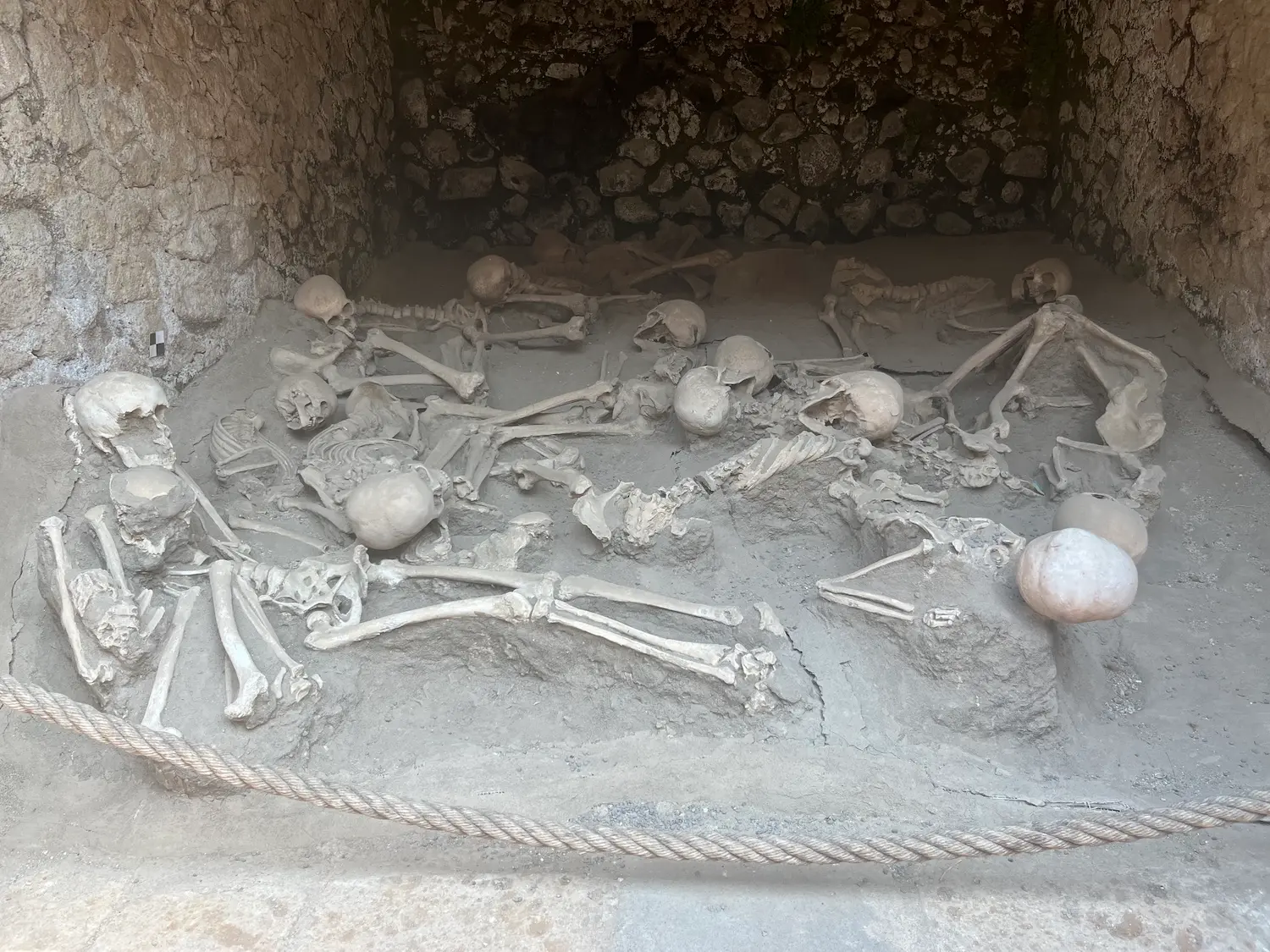
This is where one of the most distressing discoveries in the archaeological record was made. Along the ancient shoreline, in a series of barrel-vaulted boat chambers — arched storage rooms where fishing boats were kept — archaeologists found the skeletons of several hundred people. They had gathered on what was then the beach, waiting for boats to rescue them. The boats never came. The heat was so intense it caused their skulls to explode. The skeletons, now partially visible in the boathouses, are one of the most sobering sights in the entire ancient world.
Getting There by Train
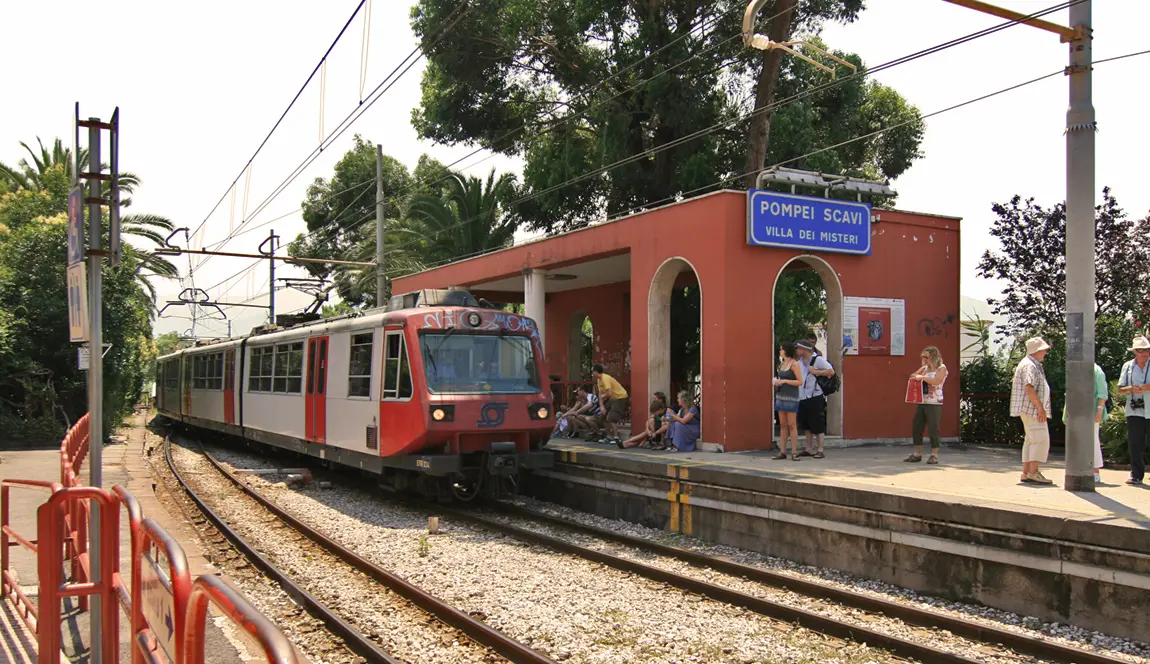
Both sites sit on the Circumvesuviana line — the regional train that runs between Naples (Napoli Piazza Garibaldi - the underground station at Napoli Centrale) and Sorrento, hugging the southern slopes of Vesuvius all the way. It is cheap and frequent.
Important: Finding the Circumvesuviana at Naples Centrale
The Circumvesuviana does not depart from the main platforms at Napoli Centrale. You need to head downstairs to Napoli Piazza Garibaldi station — follow signs for EAV or Circumvesuviana — to the underground platforms below the station. It is not well-signed. Allow yourself ten minutes to find it.
Watch the boards carefully. The Naples–Sorrento line and the Naples–Sarno line share the same underground area. You want a train going towards Sorrento. Do not board a Sarno train by mistake.
Trains depart roughly every 20–30 minutes. There is no advance booking — you simply buy a ticket at the machine or ticket desk, validate it before the barrier, and board.
Naples to Herculaneum (Ercolano Scavi)
- Journey time: ~15–20 minutes
- Ticket price: ~€2.60
- Station to site: 10-minute walk downhill along Via IV Novembre, which becomes Corso Resina
From the station, walk downhill through the modern town of Ercolano. The site entrance is at the bottom of the hill. There is something slightly surreal about this descent: you are walking through a perfectly ordinary Italian neighbourhood, with washing lines and bar terraces, and then suddenly the ancient city opens up below you in a vast excavated pit. The modern world continues above; the ancient world sits in silence beneath it.
Naples to Pompeii (Pompei Scavi – Villa dei Misteri)
- Journey time: ~35–40 minutes
- Ticket price: ~€3.30
- Station to site: 5-minute walk to Porta Marina entrance
The station drops you almost at the door. The Porta Marina entrance is the main gate and closest to the Forum. There is a quieter entrance at the other end of the site (Piazza Anfiteatro) if you want to approach from the east and work against the crowd flow.
Between Herculaneum and Pompeii
Trains run between Ercolano Scavi and Pompei Scavi on the same Circumvesuviana line. The journey takes around 20 minutes and costs approximately €3. There is no need to return to Naples in between.
Tickets and Booking
Pompeii
- Adult ticket: €20
- Under 18: Free
- EU citizens 18–25: Discounted (€2)
Book via: vivaticket.com — now the only official booking platform as of March 2026
- Daily cap: 20,000 visitors — book in advance, especially in summer
- Timed entry: Yes — the site operates timed entry slots
The first Sunday of every month is free entry for everyone (no booking needed, but expect large crowds).
Herculaneum
- Adult ticket: €16
- Under 18s: Free
- EU citizens 18–25: Discounted (€2)
- Book via: www.coopculture.it
- Pre-booking? Recommended in high season
The Campania ArteCard
If you are spending several days in the Naples region, the Campania 365 Lite Pass is worth considering as it is €26. It covers entry to both Pompeii and Herculaneum. This blog does a good job of explaining all the different passes,
One important warning: Do not buy tickets from anyone approaching you outside the Circumvesuviana stations. They are touts, and what they are selling is either fake or overpriced.
Bag restrictions
Both sites have a strict bag limitations. Larger bags and backpacks must be left in the free luggage storage at the entrance. Do not arrive with a large rucksack you are not prepared to surrender — they will turn you away.
What to See
At Pompeii
The site is 66 hectares. You cannot see all of it in a day. You should not try. Pick a direction and walk — you will find something extraordinary around every corner regardless.
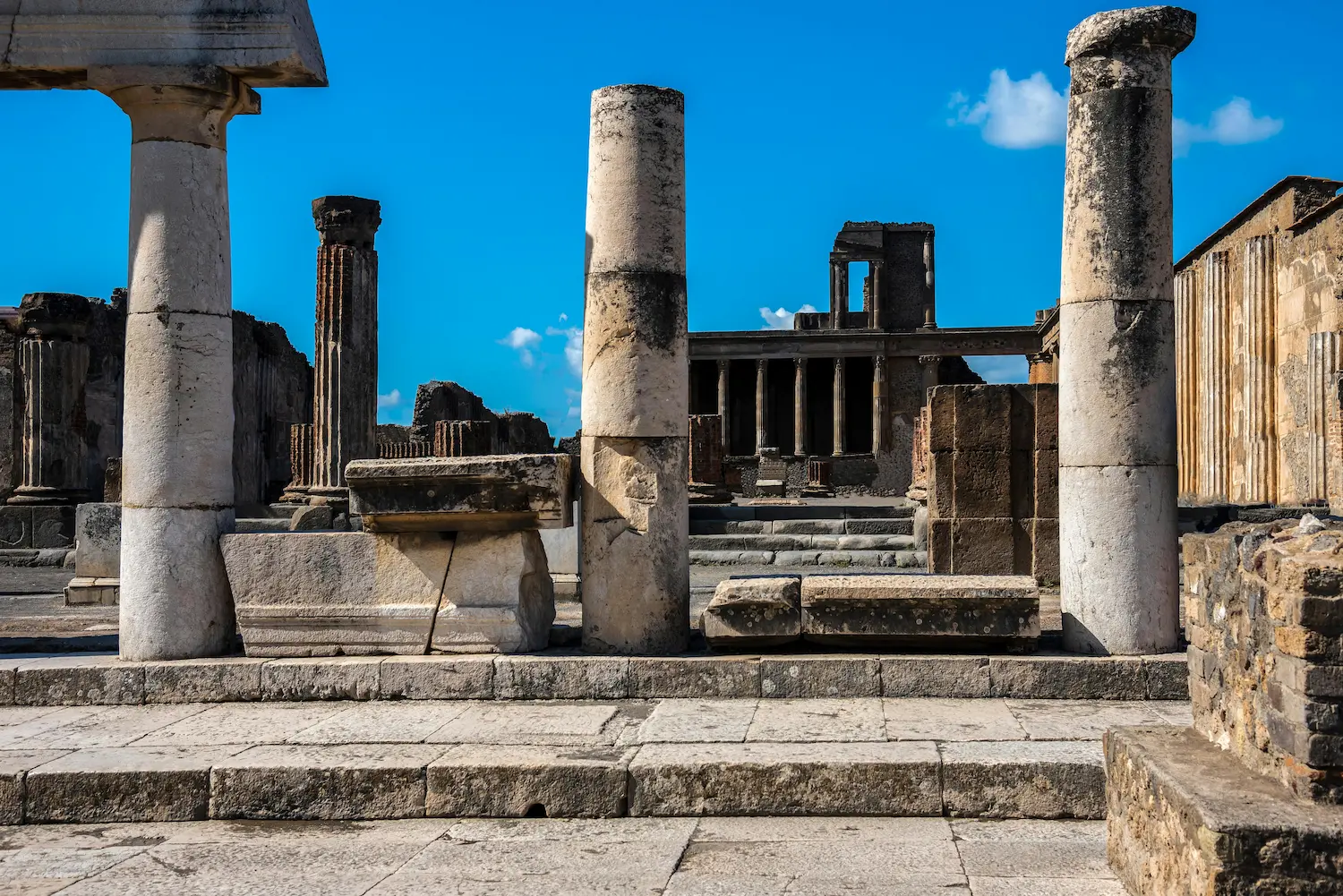
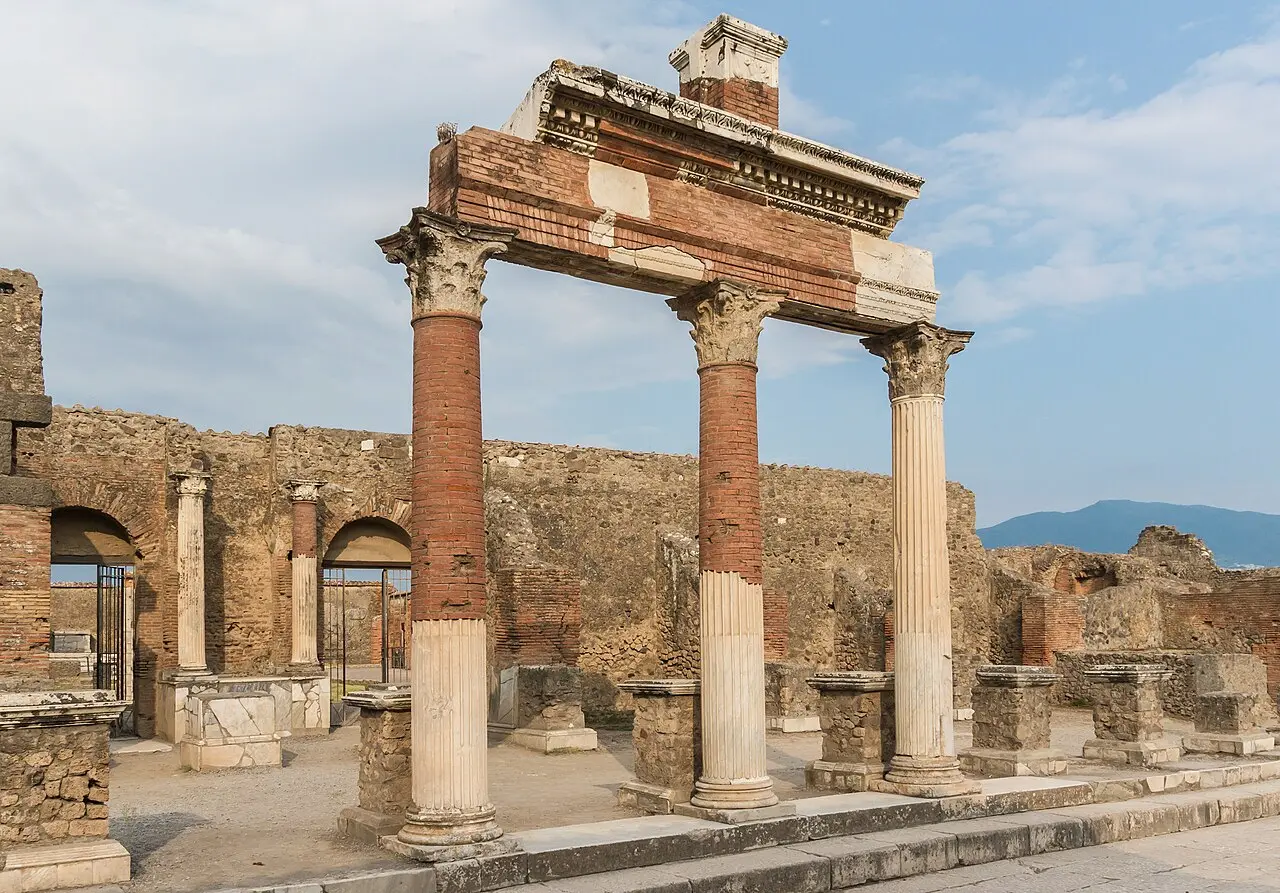
The Forum is the natural starting point: the civic heart of the city, flanked by the Temple of Jupiter with Vesuvius framed directly behind it. Stand here for a moment and absorb the view. It is one of the most powerful vistas in Italy.
The Garden of the Fugitives contains the largest group of plaster casts on the site — 13 figures, including children, in their final moments. It is not easy to look at. Do not skip it.
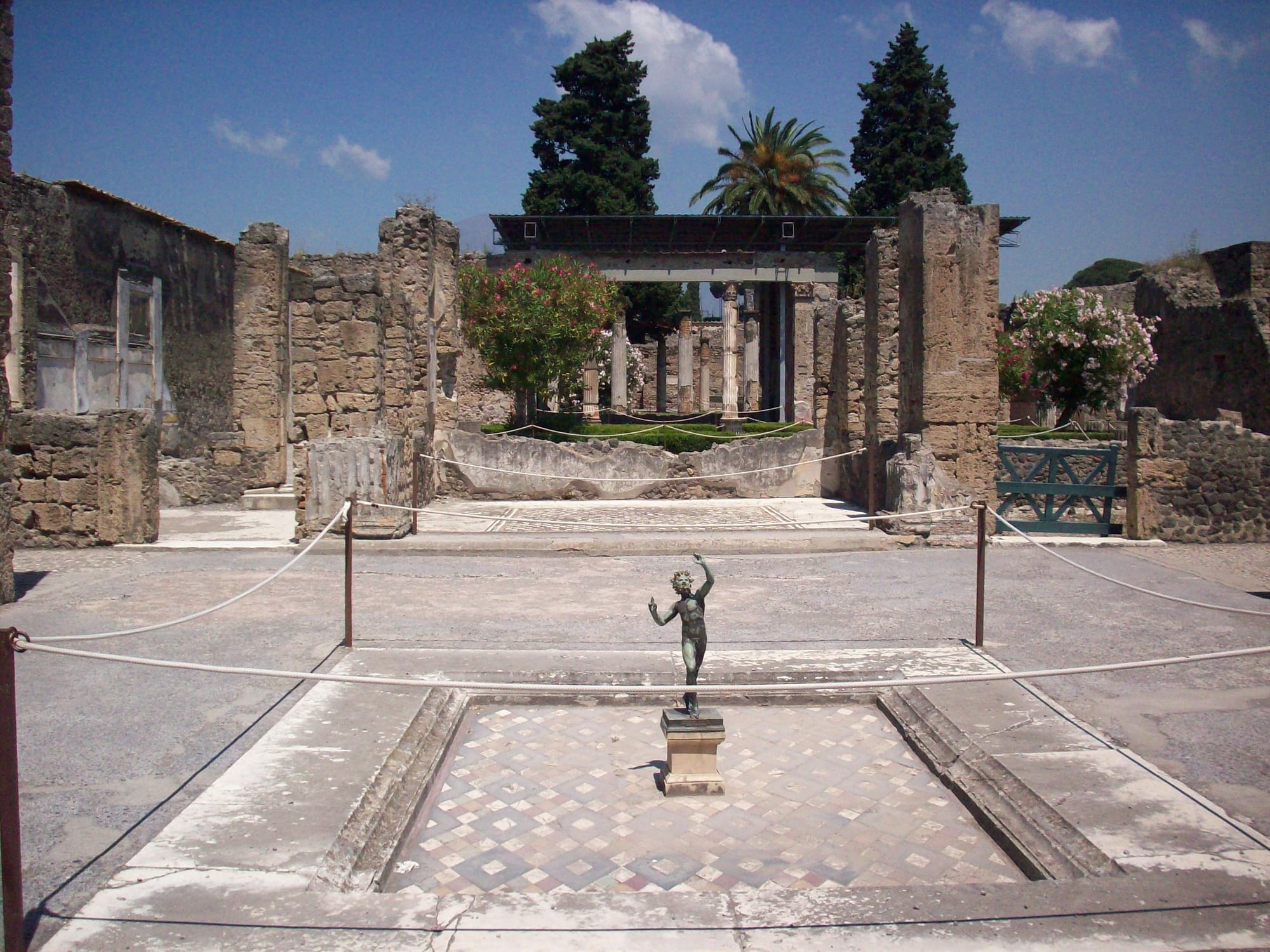
The House of the Faun is the grandest private residence in the city, where the famous Alexander Mosaic was found (now in Naples' Archaeological Museum). The bronze dancing faun in the centre of the atrium is a replica, but the space itself is magnificent.
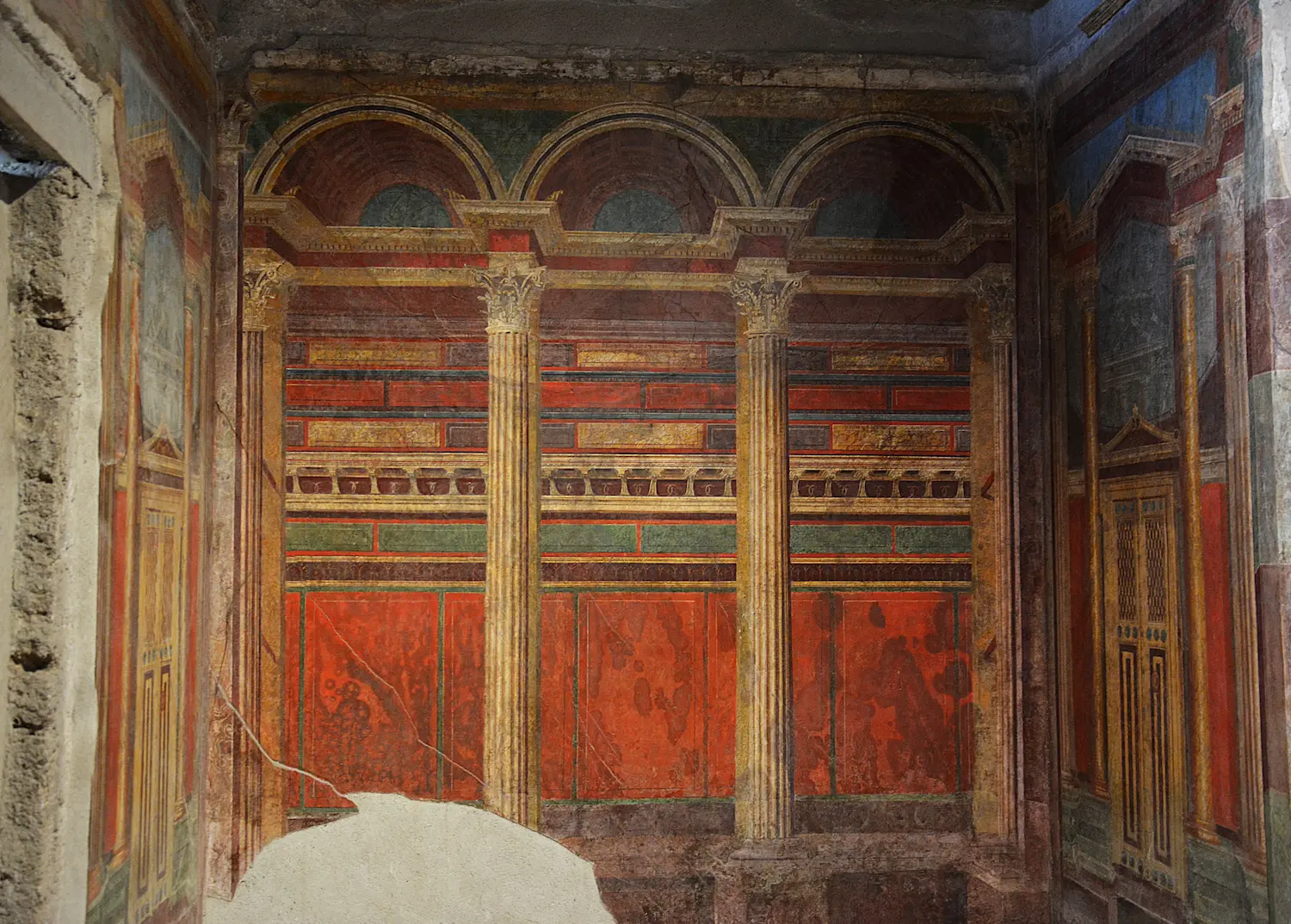
The Villa of the Mysteries, just outside the main site near the train station entrance, contains some of the most vivid frescoes to survive from antiquity — a frieze depicting what is thought to be a Dionysiac initiation rite, painted in that famous deep Pompeian red. It is extraordinary.
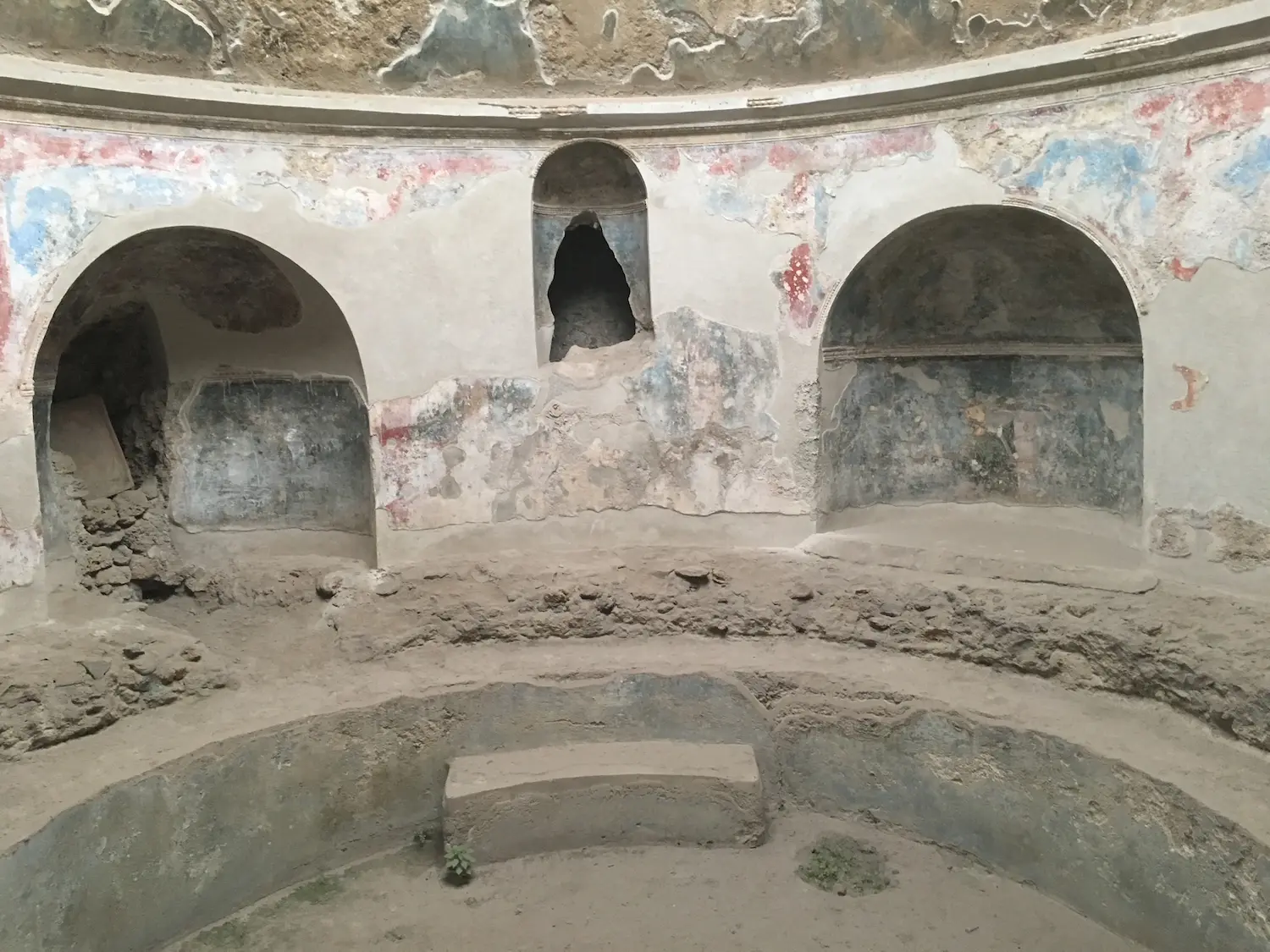
The Stabian Baths give you the clearest picture of how Roman bathing culture actually worked — the sequence of changing rooms, cold plunge, warm room, hot room.
The Amphitheatre, at the far eastern end of the site, is the oldest surviving stone amphitheatre in the Roman world, built in 80 BC. When you stand on the arena floor and look up at the banks of seating rising around you, it is hard not to feel it.
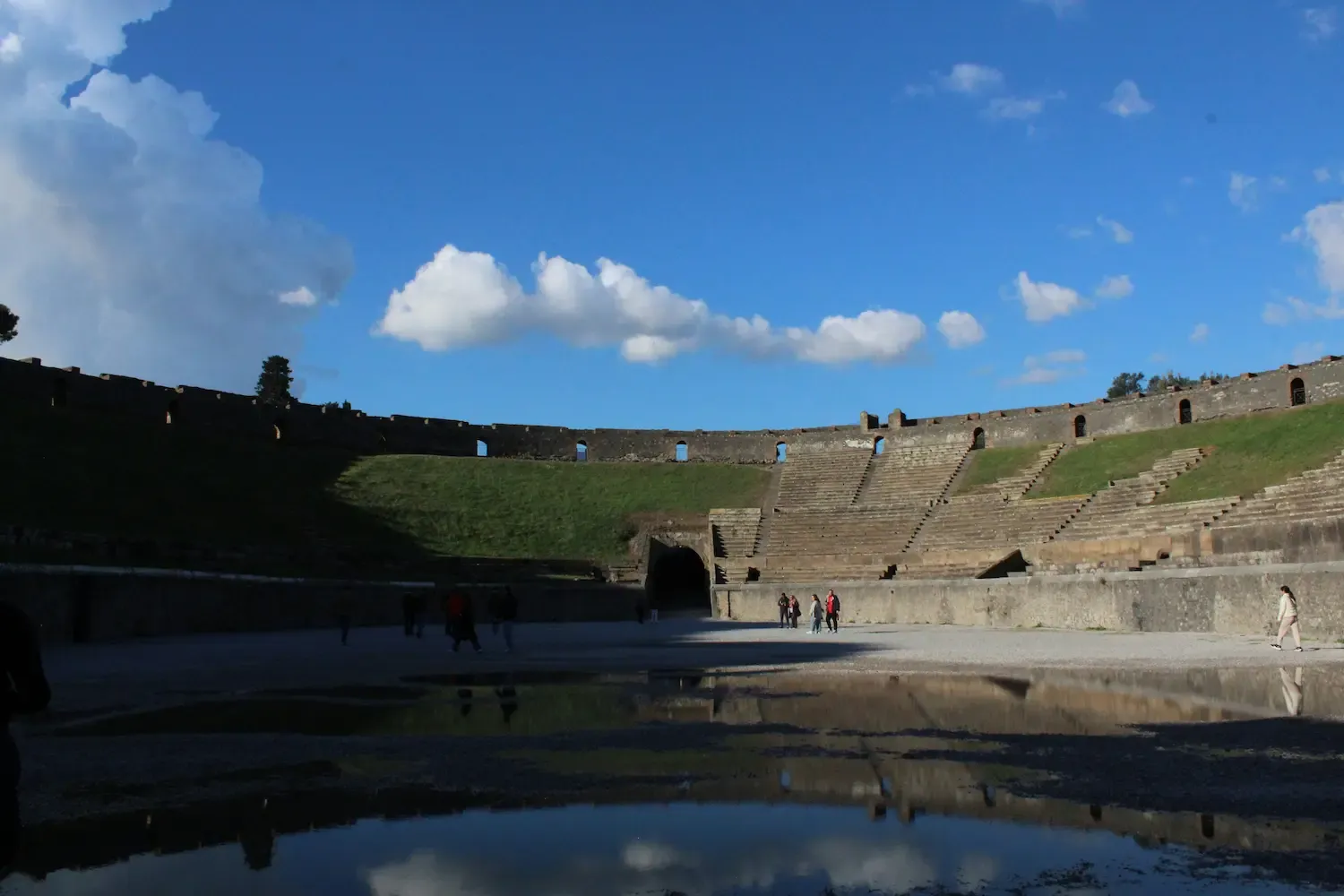
Allow at least 3–4 hours for highlights, more if you want to go deeper. A guided tour is genuinely worth it here — the site is large enough that without context, it can feel overwhelming.
At Herculaneum
Herculaneum is smaller and more manageable, but do not let that fool you into under-allocating time. The detail here rewards slow looking.
The Boathouses are the first thing you encounter. The vaulted chambers below what was once the shoreline, with the skeletons still partially visible, set the emotional register for everything that follows. This is where the people waited for the boats.
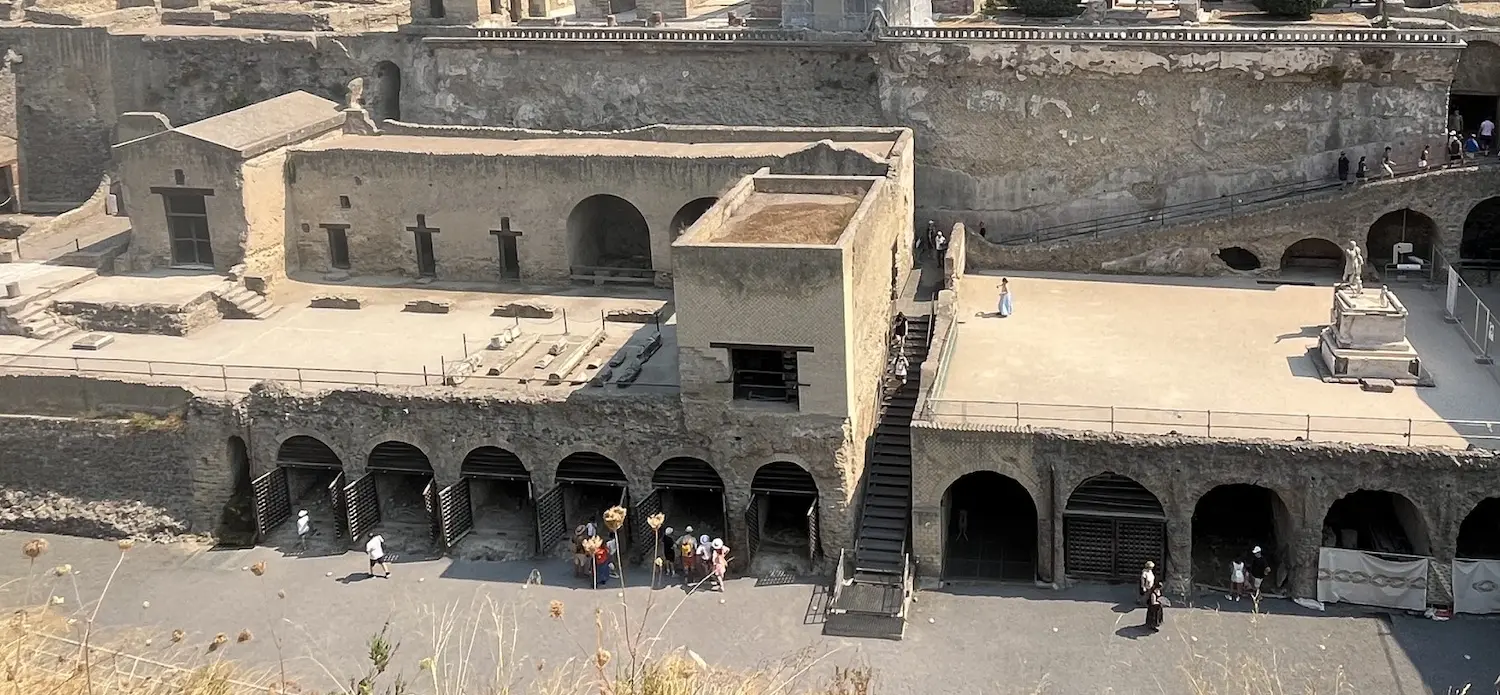
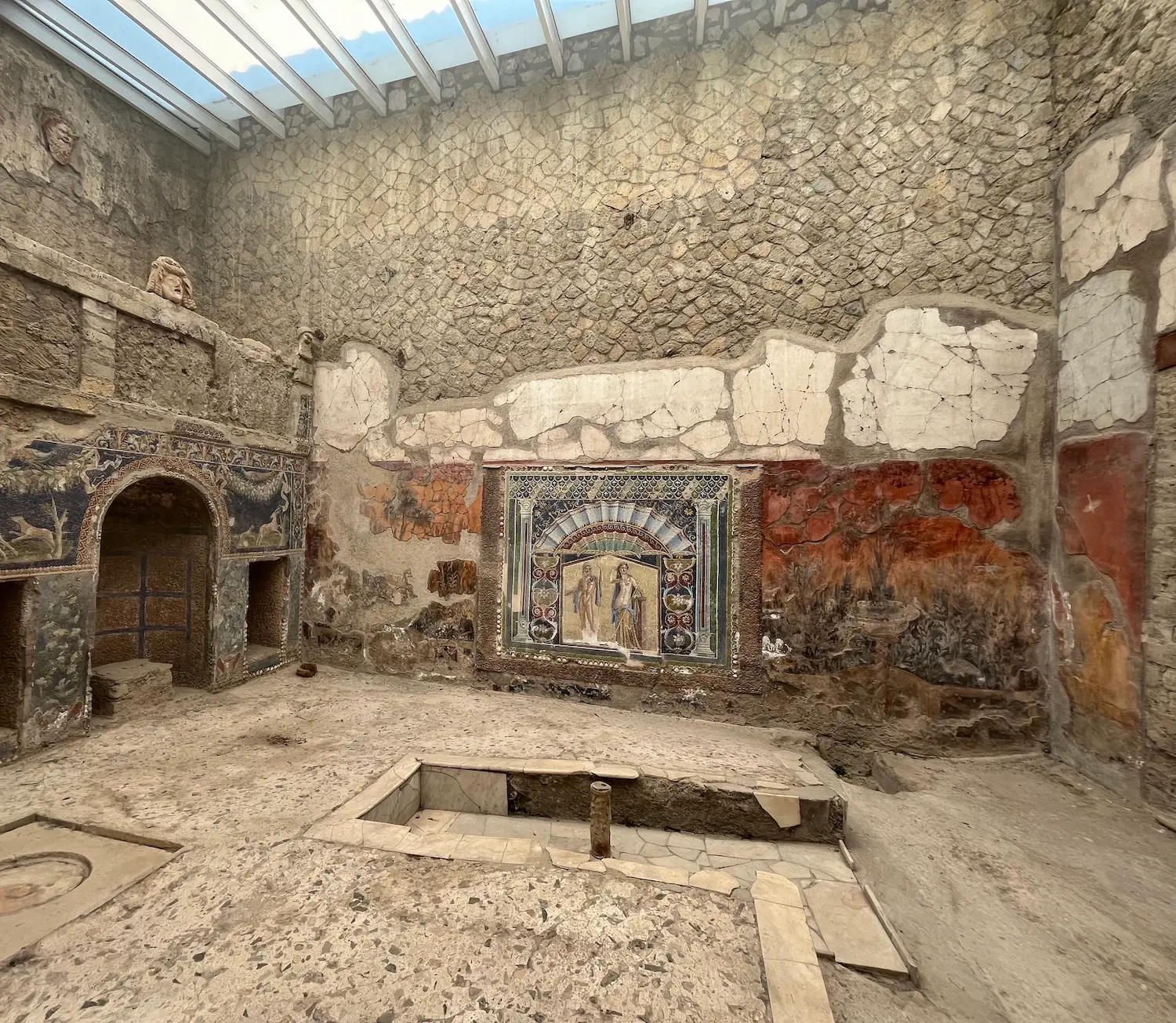
The House of Neptune and Amphitrite contains a stunning mosaic depicting the sea god and his wife — the colours are almost unbelievably vivid. It is in the summer dining room (triclinium), where you can also see the original wooden shelving from 79AD still in place.
The House of the Bicentenary is notable for what may be the earliest evidence of Christianity in a domestic setting — a cross-shaped impression on the wall of an upper room, though its interpretation is debated by scholars.
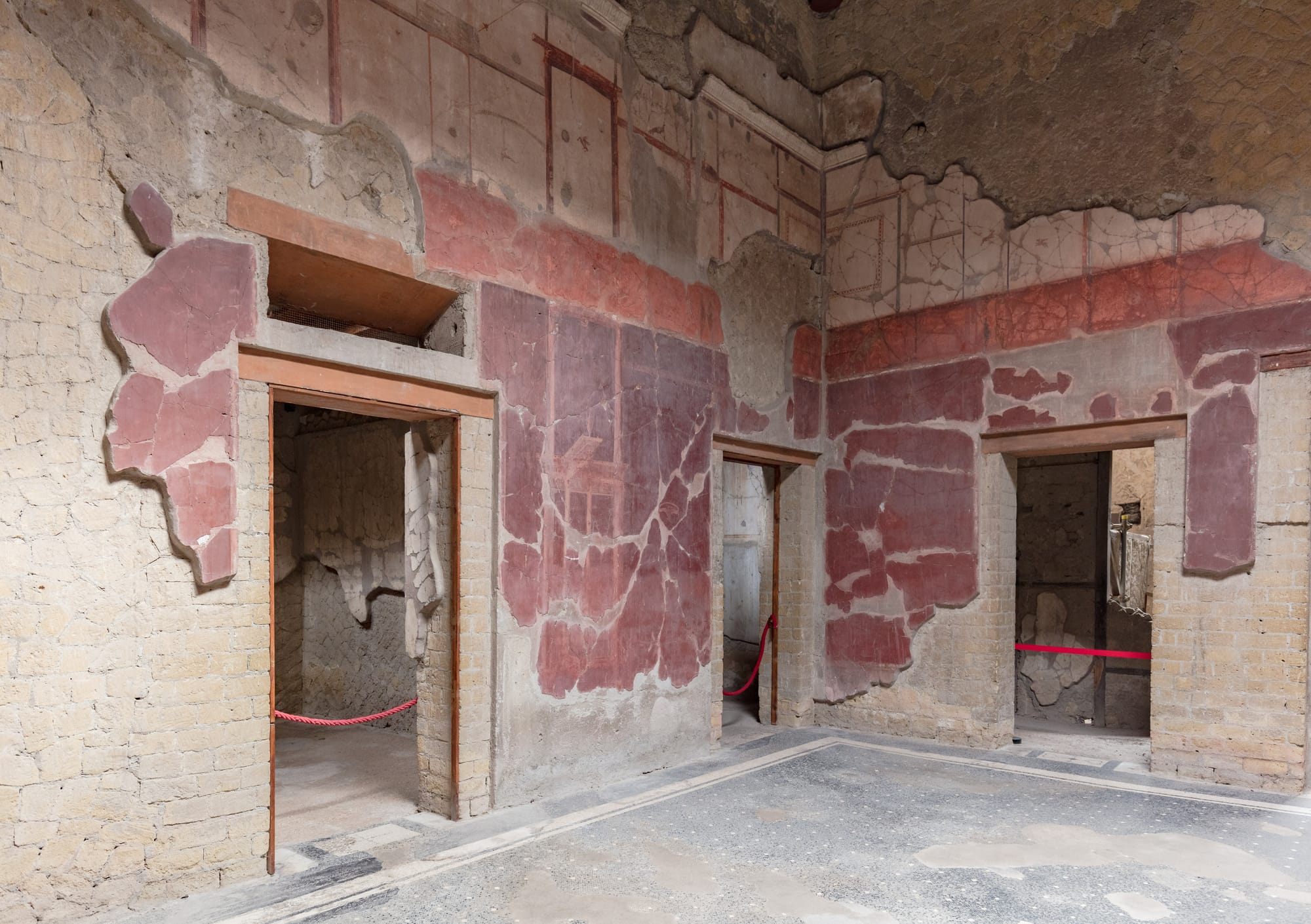
The Samnite House is one of the oldest buildings on the site, giving you a sense of the town's pre-Roman history.
The Collegium of the Augustales — a temple dedicated to the cult of the Emperor Augustus — has some of the most complete frescoes on the site, including a depiction of Hercules (after whom the town is named) entering Olympus.
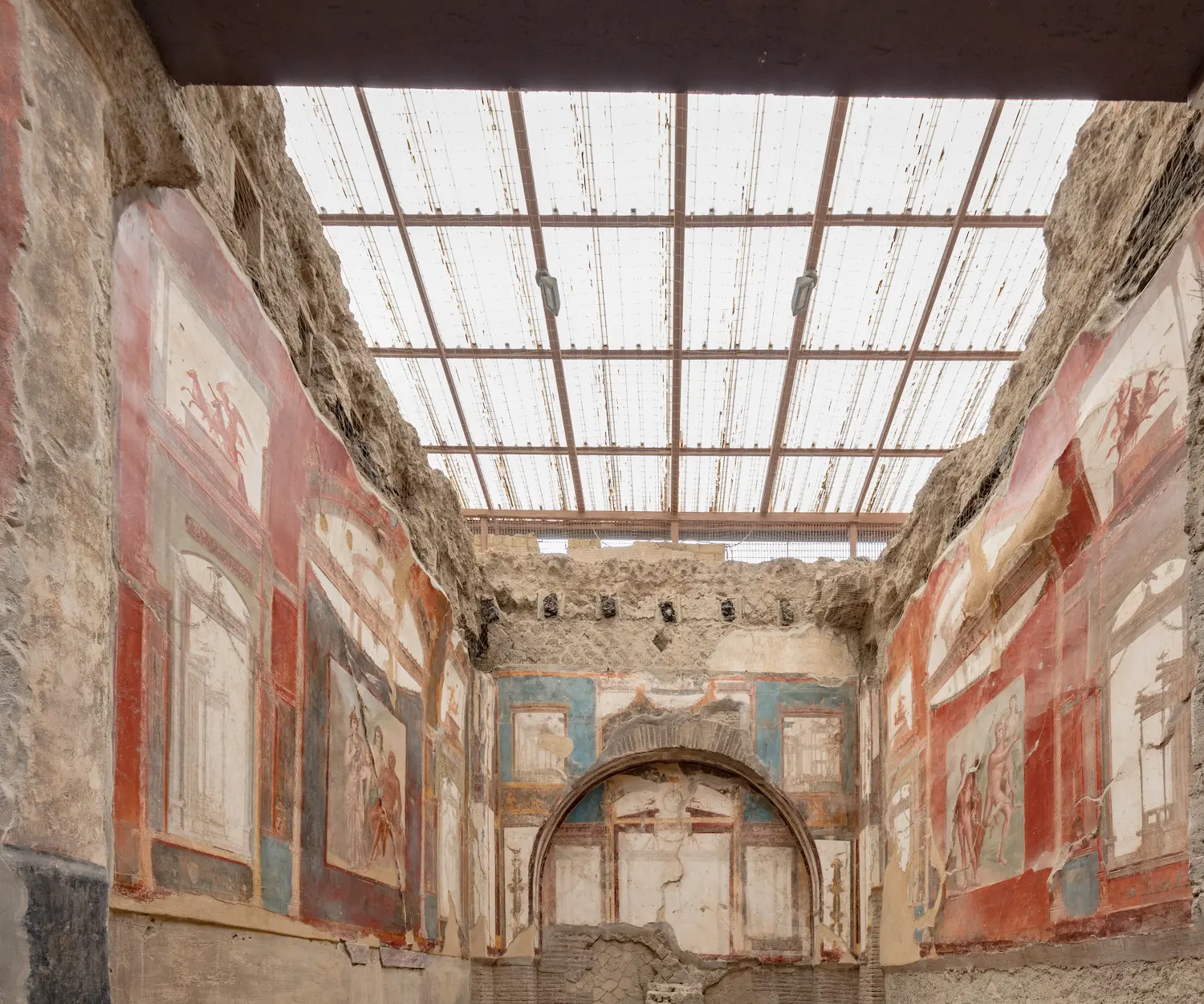
Upper floors and wooden elements: what makes Herculaneum unique is not just any single building but the cumulative effect of seeing wooden beams, doors, shutters, and furniture — organic materials that should not have survived nearly 2,000 years, but did. Nowhere else in the Roman world do you get this.
Allow 1.5–2.5 hours. The site is shaded in places but exposed in others — bring water and sun protection in summer.
Can You Do Both in One Day?
Yes. But here is an honest assessment.
If you do both in one day: Start at Pompeii (arrive for opening at 9am, spend 3–4 hours), take the Circumvesuviana to Ercolano Scavi, spend 2 hours at Herculaneum, and return to Naples by late afternoon. You will be tired and your feet will feel it. But you will have seen both.
If you split them across two days: You will enjoy each more. Pompeii especially rewards unhurried exploration — there are corners of the site that see almost no visitors, and finding them takes time. Herculaneum without the pressure of a train will enable you to take your time.
A considered recommendation: If you are staying in Naples for two or more nights, split them. If you have only one day for both, start with Pompeii and treat Herculaneum as the quieter, more intimate close to the day.
There is also a third option worth knowing about: combining Herculaneum in the morning with a hike up Vesuvius in the afternoon (or vice versa). The volcano is accessible via the Vesuvio Express minibus from Ercolano Scavi station (approximately €12 return, departs regularly in high season). Standing on the crater rim of the volcano that buried these cities — looking down towards the sea, the ruins invisible beneath the modern town — is a powerful way to end the story.
Practical Advice
Wear sensible shoes. Both sites involve walking on ancient Roman paving stones — irregular, often steep, frequently beautiful.
Go early. Both sites open at 9am. The crowds, tour groups, and heat all arrive later. Being at the Forum in Pompeii at 9:15am, before the first wave of tour coaches, is a genuinely different experience to being there at 11am.
Bring water. Pompeii has water fountains but limited shade. July and August are brutal. There are cafés inside the site, but carrying your own water is sensible.
Photography. No flash, obviously. No touching frescoes, mosaics, or wooden structures at Herculaneum. Beyond that, both sites are incredibly photogenic — allow extra time if you are a photographer.
Audio guides vs guided tours. At Pompeii, a live guide is genuinely useful — the site is large enough that context transforms what you are looking at. At Herculaneum, the site is compact enough that a good audio guide works well, though a guide adds value here too.
Staying in Naples
Naples is the right base for both sites, and it is a city that rewards staying in rather than passing through.
It is loud, chaotic, beautiful, and entirely itself in a way that no other Italian city quite matches. The pizzas are not hype. The Museo Archeologico Nazionale — which houses the finest treasures excavated from Pompeii and Herculaneum, including the Alexander Mosaic and the Secret Cabinet of erotic art — deserves at least a half-day, ideally before your site visits so you understand what you are looking at.
The Spanish Quarter, the waterfront at Mergellina, the Spaccanapoli — the long straight street that cuts the old city in two along the ancient Greek grid — all of these are worth your time.
For the sites, you want to be within walking distance of Piazza Garibaldi / Napoli Centrale, where the Circumvesuviana departs. The Spaccanapoli area puts you within a 15-minute walk. The port area is similarly convenient.
Frequently Asked Questions
Do I need to book Pompeii tickets in advance?
Yes. Pompeii now operates a daily cap of 20,000 visitors and uses timed entry. In summer especially, tickets can sell out. Book via vivaticket.com as early as possible.
How far apart are Pompeii and Herculaneum?
About 17 kilometres by road, but around 20-25 minutes on the Circumvesuviana train. They are on the same line, making it straightforward to visit both.
Which is better — Pompeii or Herculaneum?
For preservation and detail, Herculaneum. For scale and drama, Pompeii.
Pompeii is bigger, more dramatic, and more overwhelming. Herculaneum is smaller, more intact, and more intimate. If you only have time for one and want to understand Roman daily life in extraordinary detail, Herculaneum is arguably the more complete experience. If you want scale, history, and the full emotional impact of the disaster, Pompeii.
Is Herculaneum suitable for children?
Yes — and in some ways better than Pompeii for families, because it is more compact and easier to navigate. The boathouses and skeletons require some parental judgement depending on age. But the preserved wooden furniture, mosaics, and intact rooms tend to capture children's imagination well.
Can I visit Pompeii for free?
Under 18s enter free. The first Sunday of every month is free entry for everyone — but expect significant crowds on those days.
Should I visit the Naples Archaeological Museum before or after Pompeii and Herculaneum?
Before, if you can. The museum houses the finest treasures excavated from both sites — the Alexander Mosaic, the Secret Cabinet, and room after room of sculpture, glassware and everyday objects that give you the full picture of what these cities looked like when they were alive. Walking around Pompeii having already seen those objects in context is a completely different experience to arriving cold. That said, if your schedule only allows after, it is still absolutely worth it — you will find yourself recognising things you saw in situ, which has its own satisfaction.
What should I not miss at Pompeii?
The Forum (with Vesuvius behind the Temple of Jupiter), the Garden of the Fugitives, the Villa of the Mysteries, and the House of the Faun. If you have time: the Stabian Baths, the Amphitheatre, and the Lupanar (the best-preserved brothel in the Roman world, with frescoes above each room indicating the services on offer).
What should I not miss at Herculaneum?
The boathouses and their skeletons, the House of Neptune and Amphitrite (for the mosaic), the Collegium of the Augustales (for the frescoes), and simply the wooden elements scattered throughout — doors, shelves, beams — that make this place unlike anywhere else.
The Bottom Line
Pompeii and Herculaneum are not just archaeological sites. They are two communities stopped mid-sentence. The bread in the oven, the election slogan half-painted on the wall, the boats that never came. The volcano preserved them. The train gets you there in half an hour from Naples.
Go. Allow more time than you think you need. And probably visit the Archaeological Museum in Naples either before or after — the treasures removed from both sites over the past 250 years of excavation are extraordinary, and they make everything you have seen make more sense.
Related reading on The Unseen Italy:
- Italy by train: your complete guide to the network
- Orvieto by train: a day trip from Rome or Florence