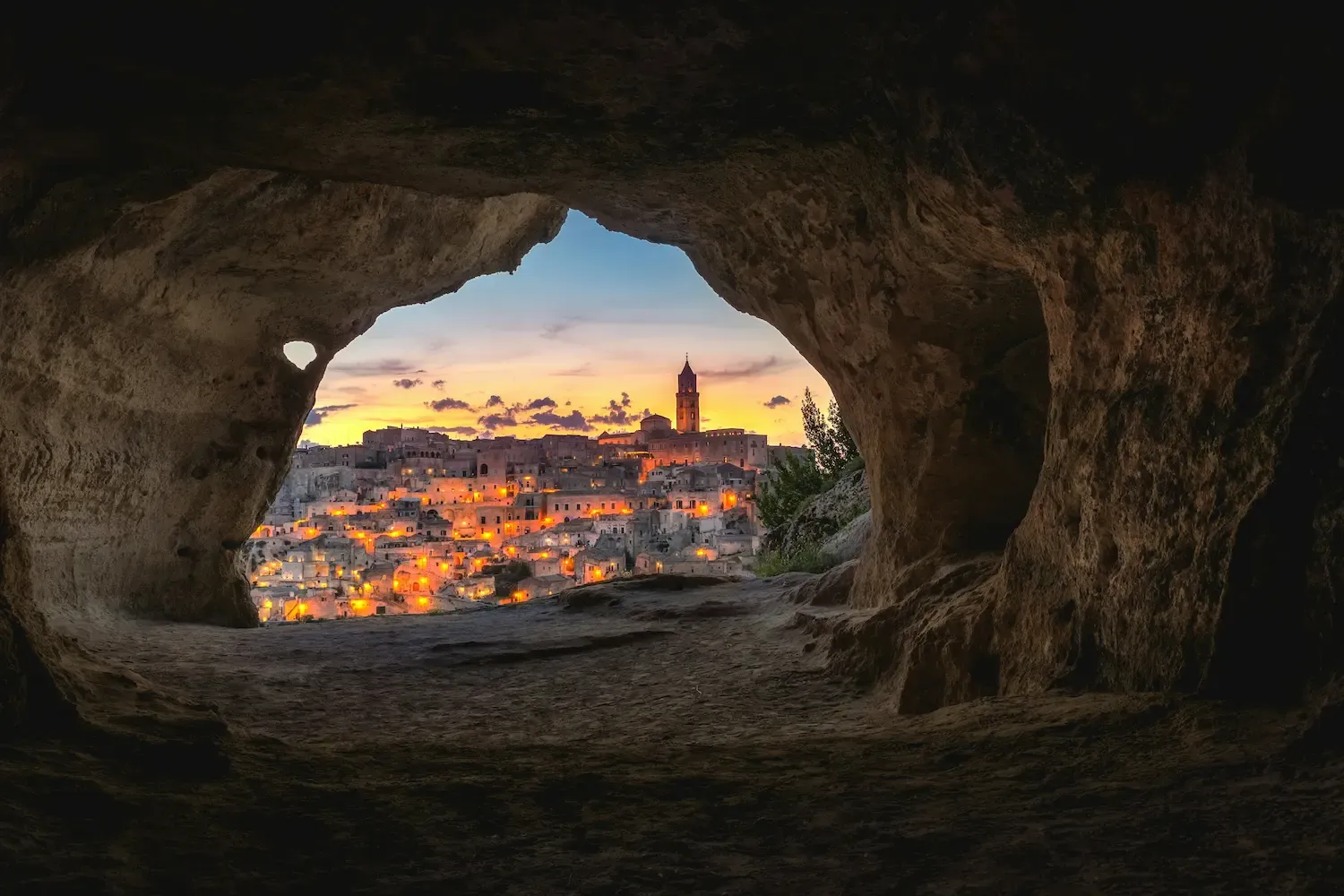
Matera is one of the most extraordinary places in Italy - cave dwellings carved from limestone, an underground cistern the size of a cathedral, and a suspension bridge across a ravine. And entirely reachable without a hire car.
Last verified: June 2026. Train, plane and bus times, prices and opening hours change regularly. Always check official sources before travelling.
Few cities in Italy stop people in their tracks the way Matera does. A UNESCO World Heritage site, the European Capital of Culture in 2019 and the filming location for No Time to Die and The Passion of the Christ. It is also, by the standards of this site, a logistical challenge - Matera sits in the heart of Basilicata, one of the least-visited regions in Italy. But it is entirely reachable without a hire car: by train or plane to Bari then bus, or by Flixbus direct from Rome or Naples. The journey is long. The destination is worth it.
At a Glance
| 🚆 Train from Rome via Bari | Roma Termini to Bari Centrale ~4h 40 mins (Trenitalia), then bus to Matera ~1h 15m |
| ✈️ Plane to Bari then bus | Ryanair Rome Fiumicino to Bari ~1 hour 10 mins, then Cotrap/Cotrab bus ~1h 15m to Matera | 🚌 Flixbus from Rome or Naples | Direct to Matera - approx. 6.5 hours from Rome, from ~€20, - approx. 3.5h from Naples |
| 🏨 Where to stay | In the Sassi - in either Sasso Barisano or Sasso Caveoso |
| ⏱️ Time needed | Two nights - enough to see everything at a relaxed pace |
| 📅 Best time | Spring and autumn - hot in summer, cool in winter |
| 👟 Essential | Comfortable walking shoes - the Sassi involves many steps and steep inclines |
In This Guide
Getting to Matera Without a Car
While Matera is located in a somewhat remote location, the good news is that several practical and reliable public transport options exist - with the route via Bari being the most flexible.
Option 1 - Train to Bari, then Bus to Matera (Recommended)
This is the most comfortable and flexible approach. Take a high-speed Frecciarossa (Trenitalia) from Rome to Bari Centrale - around 4 hours and 40 mins, with tickets from around €35 if booked in a couple of months in advance via Trenitalia or Trainline. From Naples, Bari is around 3 hours 30 mins on the same line.
From Bari, multiple bus operators run direct services to Matera throughout the day in around 1 hour 15 minutes. These run from directly outside Bari Centrale train station (in Via Capruzzi). Operators running the route from Bari to Matera include Itabus, Flixbus or Miccolis. Fares from Bari to Matera start from around €10.
These buses arrive at Via Don Luigi Sturzo bus terminal. This is about a 30-35 minute walk to the Sassi. If you have heavy luggage, or don't fancy the walk - the number 10 bus runs about every half an hour and will get you to within 10-15 minutes walk of the Sassi.
Option 2 - Fly Ryanair Rome to Bari, then Bus to Matera (a second alternative option)
Ryanair and ITA fly from Rome Fiumicino (Leonardo da Vinci) to Bari, with fares with Ryanair often under €40 return - making this a pretty good route if you time it right.
From Bari airport, direct buses to Matera run approximately every two hours, operated by Cotrab and Cotrap (with rather confusingly similar names), taking around 1 hour 15 minutes and arriving at Via Aldo Moro (next to Piazzale Matteotti). Fares from the airport are around €4–6.
While I prefer Option 1, I would day that this option (Option 2) is also a relatively easy and good alternative.
Option 3 - Train to Bari, then local Train to Matera (slower but doable)
If you arrive in Bari by train, then another option available is to take the local train from Bari to Matera. Personally I would take the bus, as they are more frequent and take less time. But if you prefer to arrive in a central location in Matera then this is your alternative.
The trains run approximately every hour, and take 2 hours to reach Matera, with a change in Altamura. They arrive in Matera Centrale Station which is about 10-15 minutes walk from the Sassi. They are run by Ferrovie Appulo Lucane (a separate train company from Trenitalia). You can check the train timetable and buy tickets online. The train does not run on Sundays.
Option 4 - Train to Ferrandina, then Bus (not recommended)
From Rome, direct Trenitalia services reach Ferrandina Scalo Matera in around 4.5 hours to 5.5 hours depending on the service. From Ferrandina Scalo station, buses operated by FAL (Ferrovie Appulo Lucane) run to Matera in approximately 45 minutes - around seven times a day. Check timetables at fal-srl.it. Please note that these buses do not run on Sundays.
This route is more direct in theory but less flexible in practice - the FAL bus timetable is sparse and the station itself is in the middle of nowhere. The Bari route is simpler and more reliable.
Option 5 - Flixbus Direct from Rome or Naples
Flixbus runs direct coaches from Roma Tiburtina to Matera twice daily, taking around 6 hours 30 minutes and costing from around €20. The bus is the cheapest option and the simplest logistically - no connections - but six and a half hours on a coach is a significant day of travel. Worth considering if you're on a tight budget or want the simplest possible journey regardless of time.
From Naples, direct services are also available. They run 4 times a day, take 3.5 hours, and cost about €13. So if you are starting from Rome, you could take the train from Rome and then pick up the bus in Naples, if you want to break up your journey.
The Sassi - Sasso Barisano and Sasso Caveoso
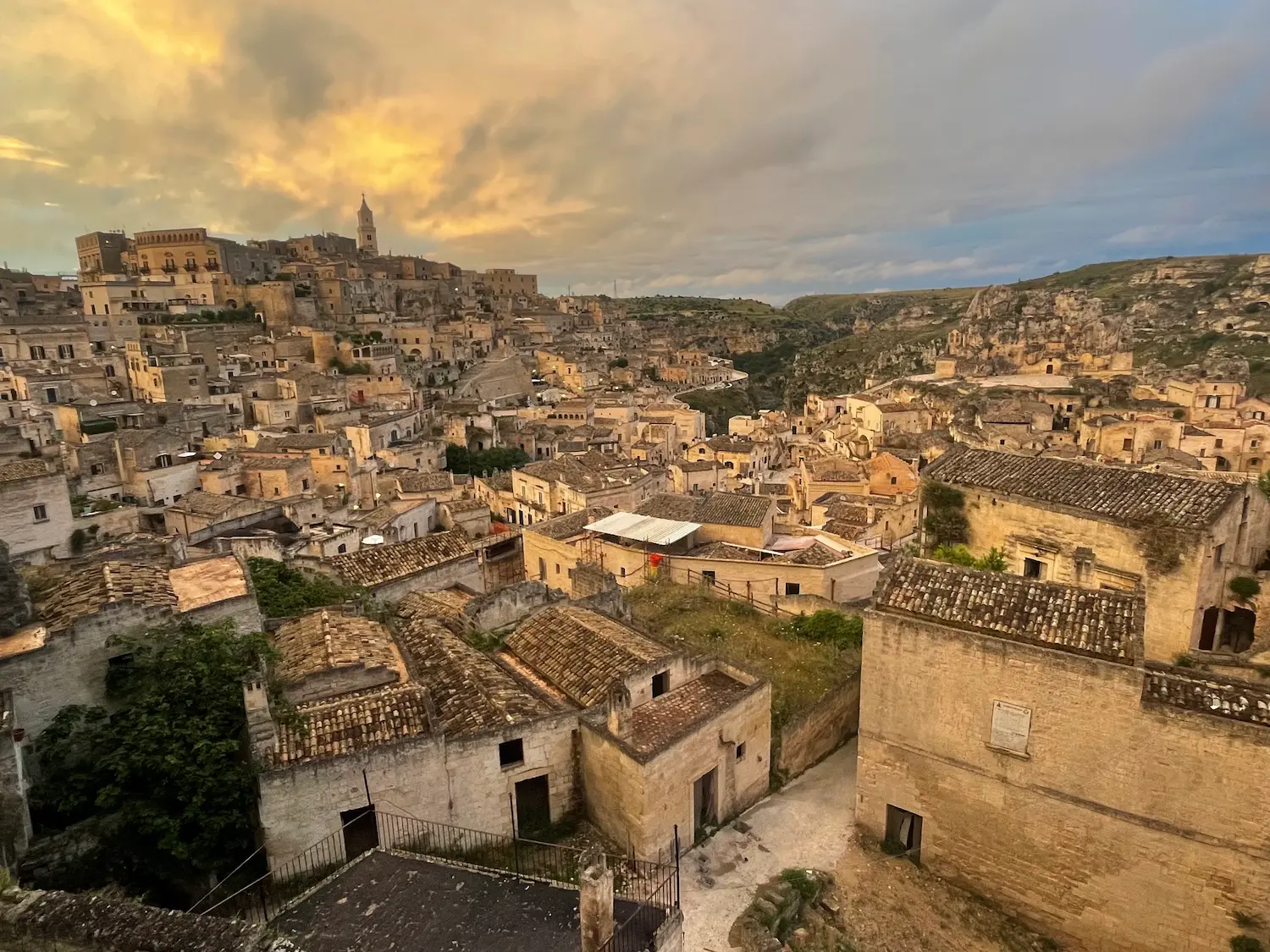
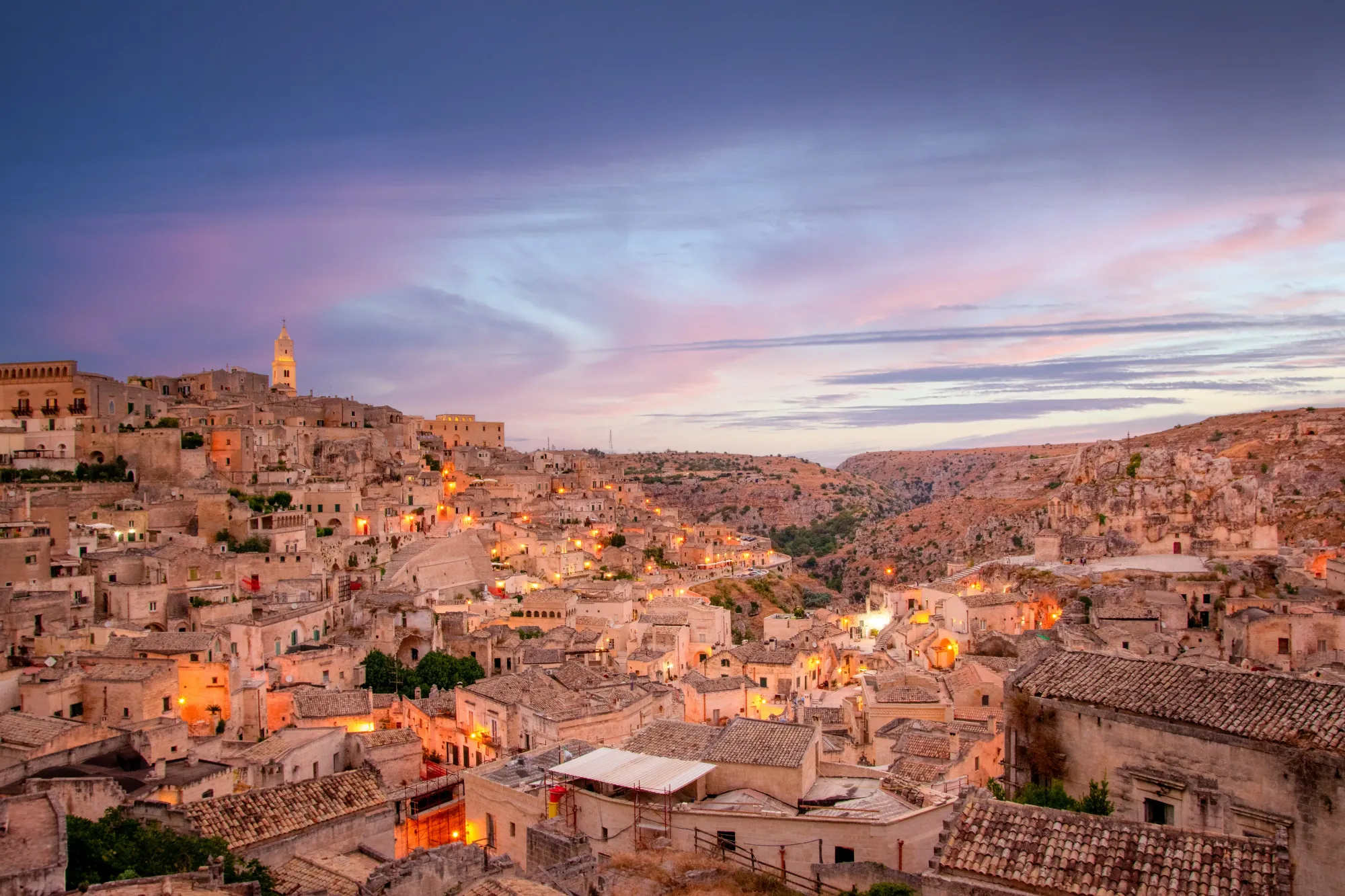
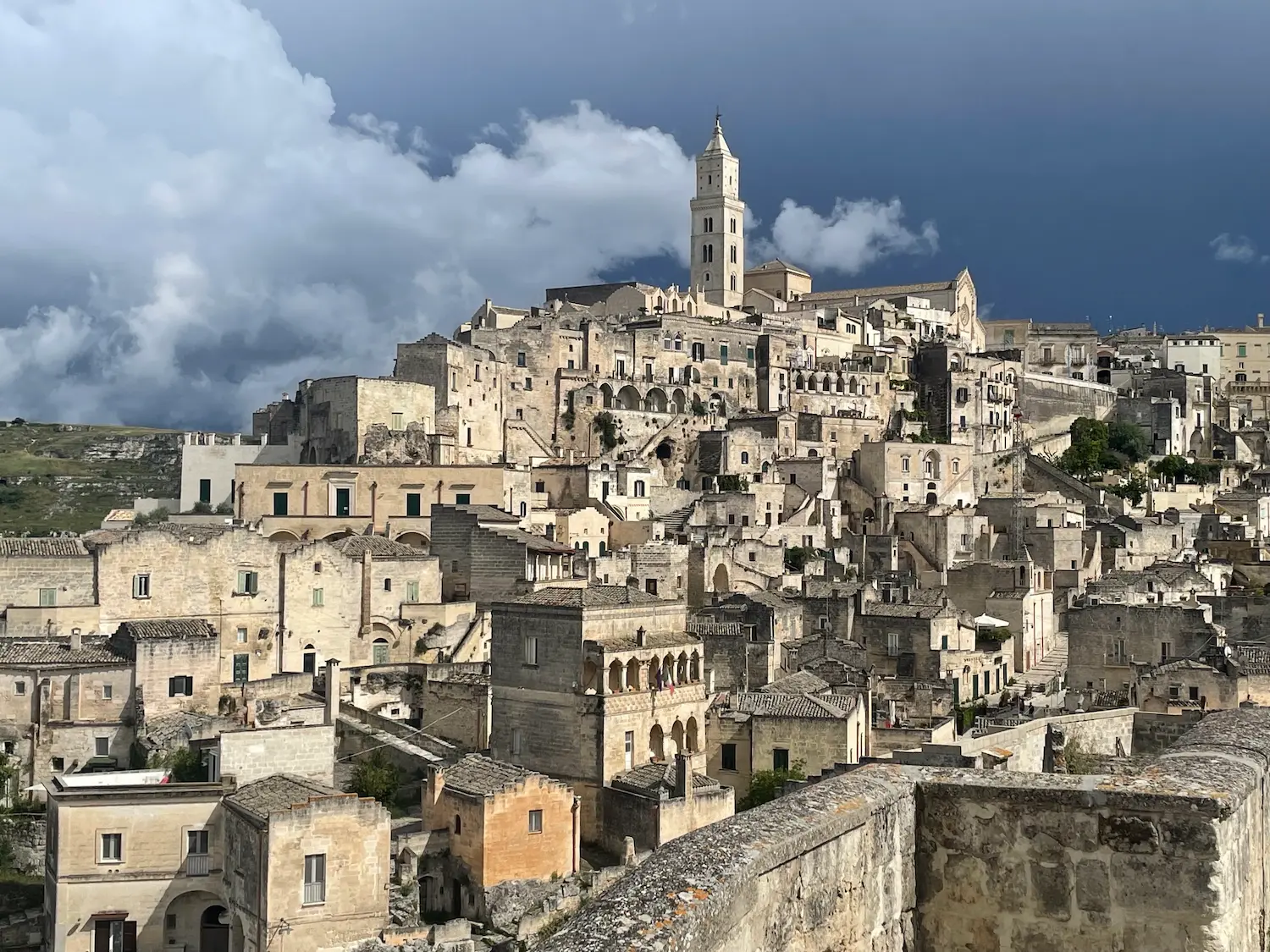
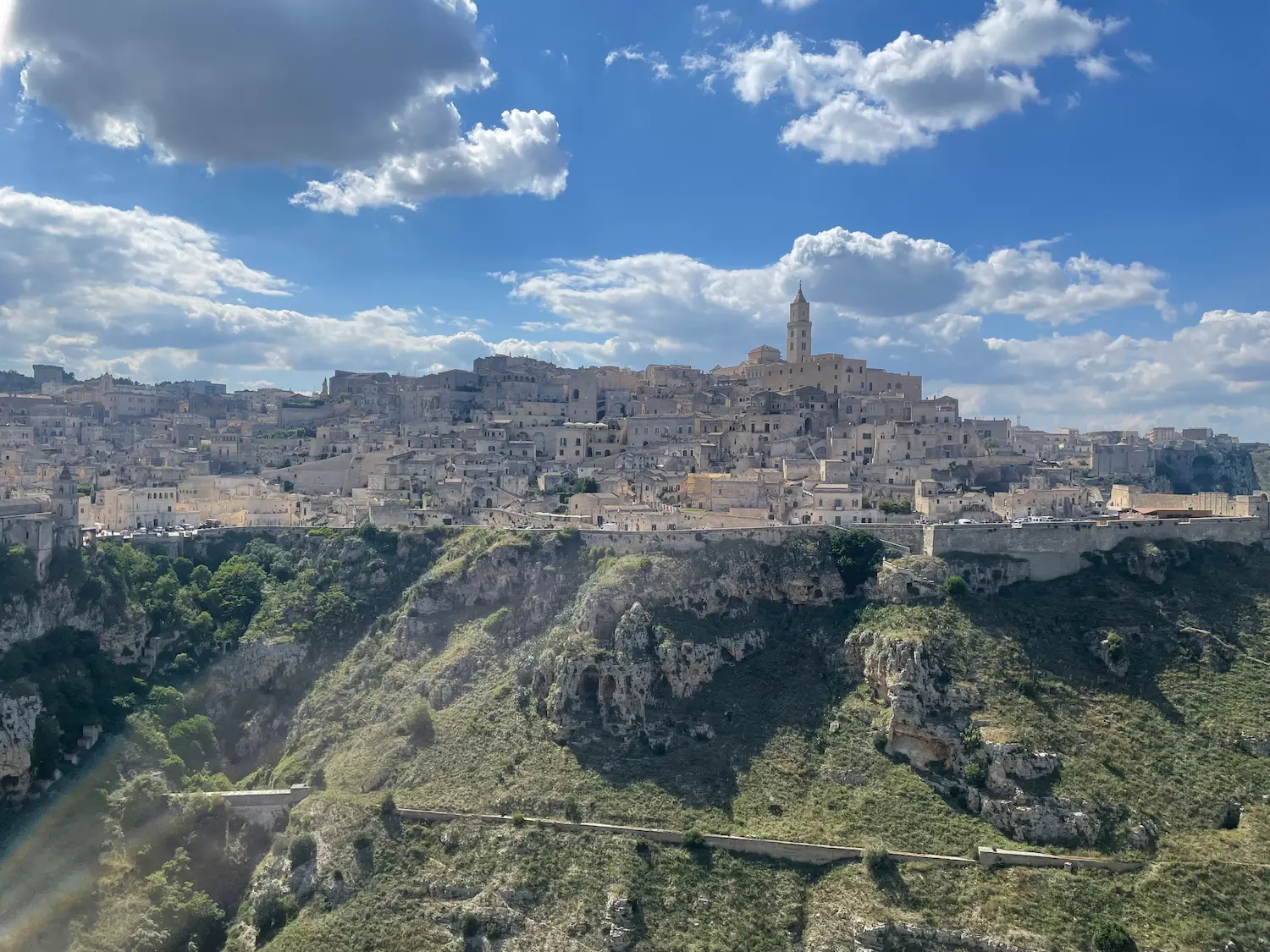
The Sassi di Matera are the reason everyone comes - two ancient districts of cave dwellings carved into the limestone ravines of the Gravina canyon, inhabited continuously for at least nine thousand years. The houses, churches, cisterns and passages are cut directly from the rock, stacked vertically up the canyon walls in a way that makes the whole city look like a scene from another world. Walking into the Sassi from the modern city feels like passing through a door in time.
Sasso Barisano is the more renovated and accessible of the two districts - more cave hotels, restaurants and artisan shops, more visitor infrastructure generally. This is where most people stay and where most tour groups go.
Sasso Caveoso retains a rawer, quieter character - less restored, steeper, more atmospheric. The unrestored cave facades and the quieter lanes give a stronger sense of what the Sassi were before the renovation.
Both districts are free to enter and open 24 hours. The magic of the Sassi is in wandering - taking wrong turns, descending staircases that open onto unexpected viewpoints, finding cave churches where you weren't expecting them. Give yourself time and resist the urge to follow a rigid plan.
Cave Tours and What to See Underground
A guided cave tour is the best way to understand what you're looking at in the Sassi - the layers of history, the water systems, the way successive generations adapted the rock to their needs.
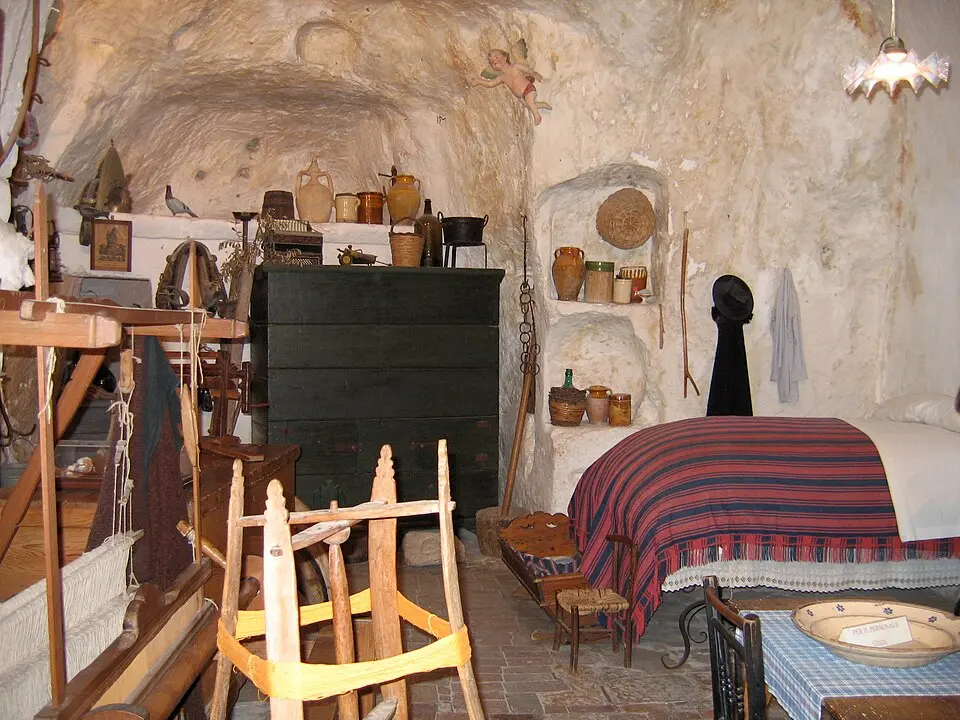
Casa Grotta di Vico Solitario is one of the most moving of the accessible cave dwellings - a reconstructed family home showing how people lived in these spaces until the 1950s, when the Italian government forcibly relocated the entire population of the Sassi to new housing, considering the cave dwellings a national shame. The reconstruction shows beds, cooking tools, a manger for animals (often sharing the same space as the family), and the cistern system that collected rainwater from the roof. Entry around €8.
Casa Noha is a multimedia introduction to the history of the Sassi - a UNESCO -sponsored exhibition in a renovated cave dwelling using projections and film to tell the story of the city from prehistoric times to the 20th-century evacuation. A useful context-setter before wandering the Sassi themselves. Entry around €9. Book ahead in peak season.
Sassi in Miniatura — tucked into a small workshop on Via Fiorentini, near the Cathedral, this is one of those discoveries that rewards wandering without a plan. Artist Eustachio Rizzi spent three years from 1996 carving a precise scale model of the entire Sassi from limestone — covering around 12 square metres and weighing over a tonne. Every street, staircase, neighbourhood, balcony and cave dwelling reproduced exactly as he remembered it. Entry is free, with a small donation appreciated. The workshop also sells handmade tuff stone sculptures and souvenirs.
Guided tours - Multiple operators run guided walking tours of the Sassi - group tours typically cost €25–40 per person for two to three hours. Private guides charge more but offer more depth. If you're visiting in summer, book in advance - the best guides are heavily in demand.
Palombaro Lungo — The Underground Cistern
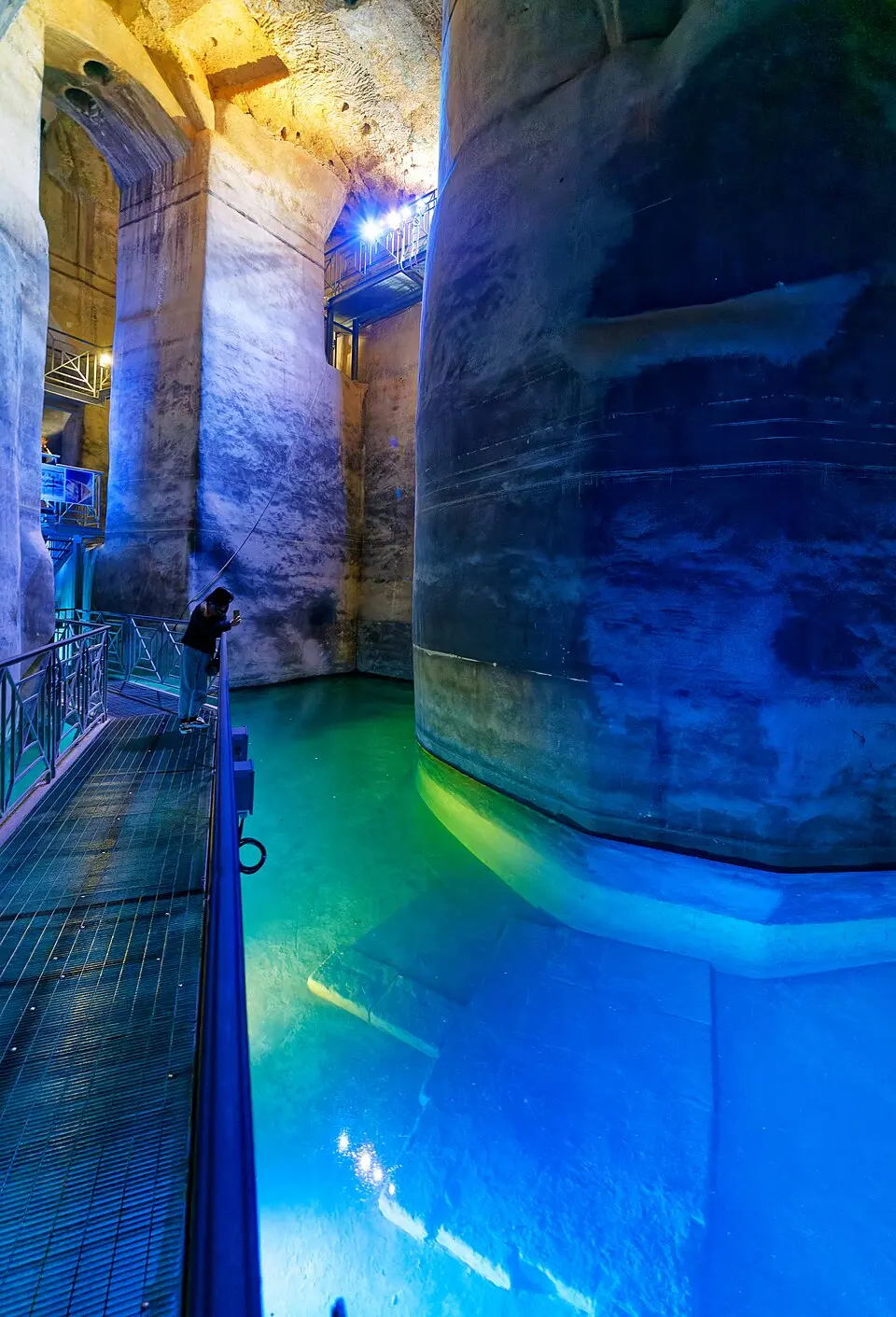
Beneath Piazza Vittorio Veneto - Matera's main square - lies one of the most extraordinary engineering achievements in southern Italy: the Palombaro Lungo, a vast underground cistern hand-carved from the rock over several centuries, with a capacity of five million litres of water. This is the cistern system that is central to Matera's UNESCO designation - water management was the defining challenge of life in the Sassi, and the Palombaro Lungo is its most dramatic expression.
Descending into the cistern from the square above is genuinely astonishing. The scale of the space - cathedral-like arches cut from rock, stretching in every direction below the modern city - gives an immediate physical sense of the extraordinary engineering these inhabitants achieved.
Visits are by guided tour only, lasting around 30 to 45 minutes. Entry costs around €3 and tickets can be bought directly at the ticket office.
The Rope Bridge and the Murgia Viewpoint
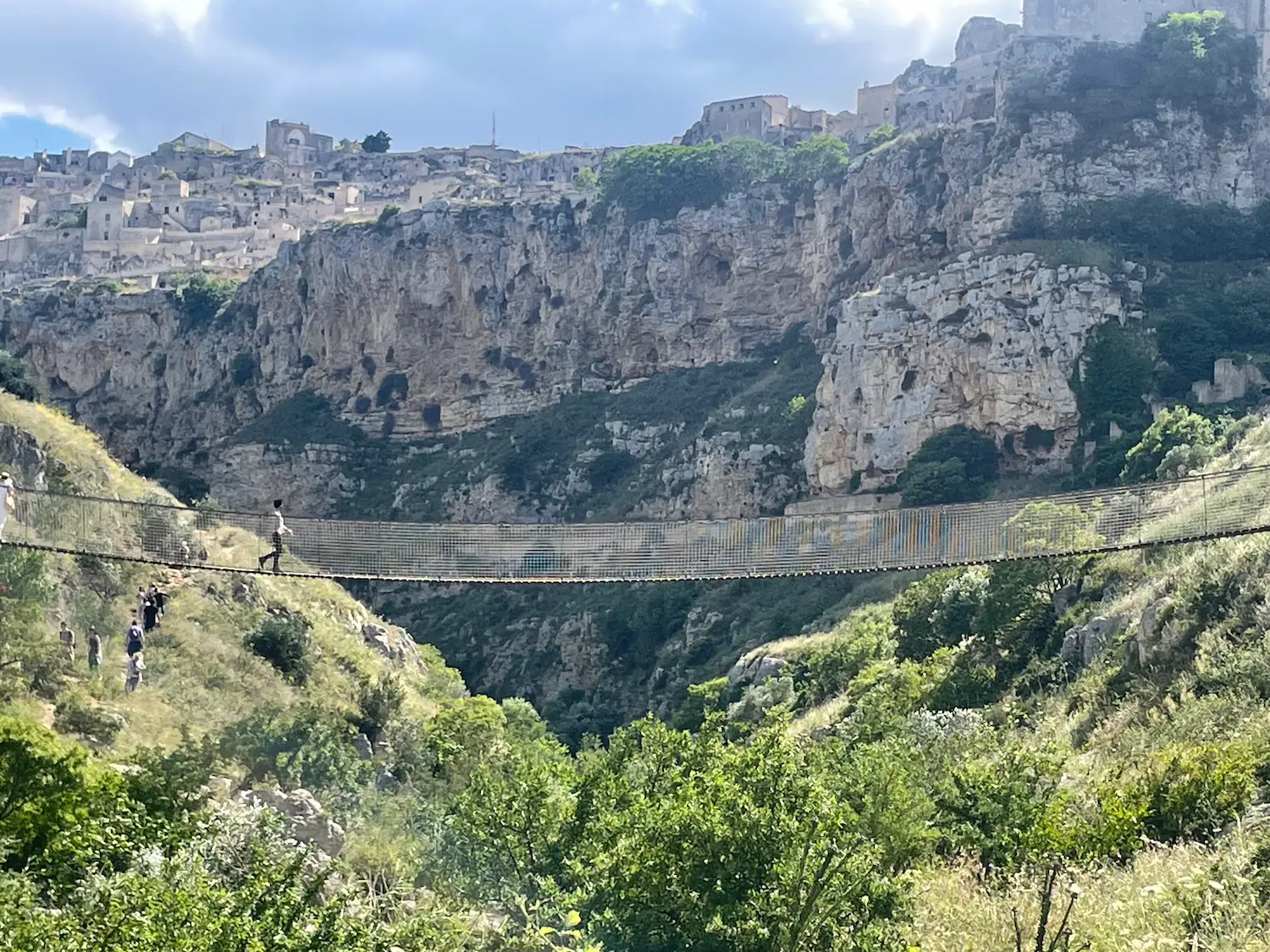
The Ponte Tibetano - the suspension bridge across the Gravina ravine - was opened in 2012 and crosses from the Sassi to the Murgia Materana park on the opposite side of the canyon. The bridge sways gently across the shallow canyon, and it is fun to look up at the Sassi as you cross it.
On the far side, the Belvedere di Murgia Timone offers the most famous panoramic view of Matera - the entire Sassi face-on, the cave dwellings stacked up the canyon walls, the cathedral on the Civita ridge above. This is the angle from which Matera looks like a nativity scene, - in fact, the city is used as a setting for presepe (nativity scene) recreations every Christmas. At golden hour, with the sun dropping behind the modern city and the warm limestone glowing, it is extraordinary.
The walk across the bridge and to the viewpoint takes around 30 to 45 minutes each way. Wear proper shoes - the paths on the Murgia side are uneven and dusty. The bridge and park are free to enter.
The Rupestrian Churches
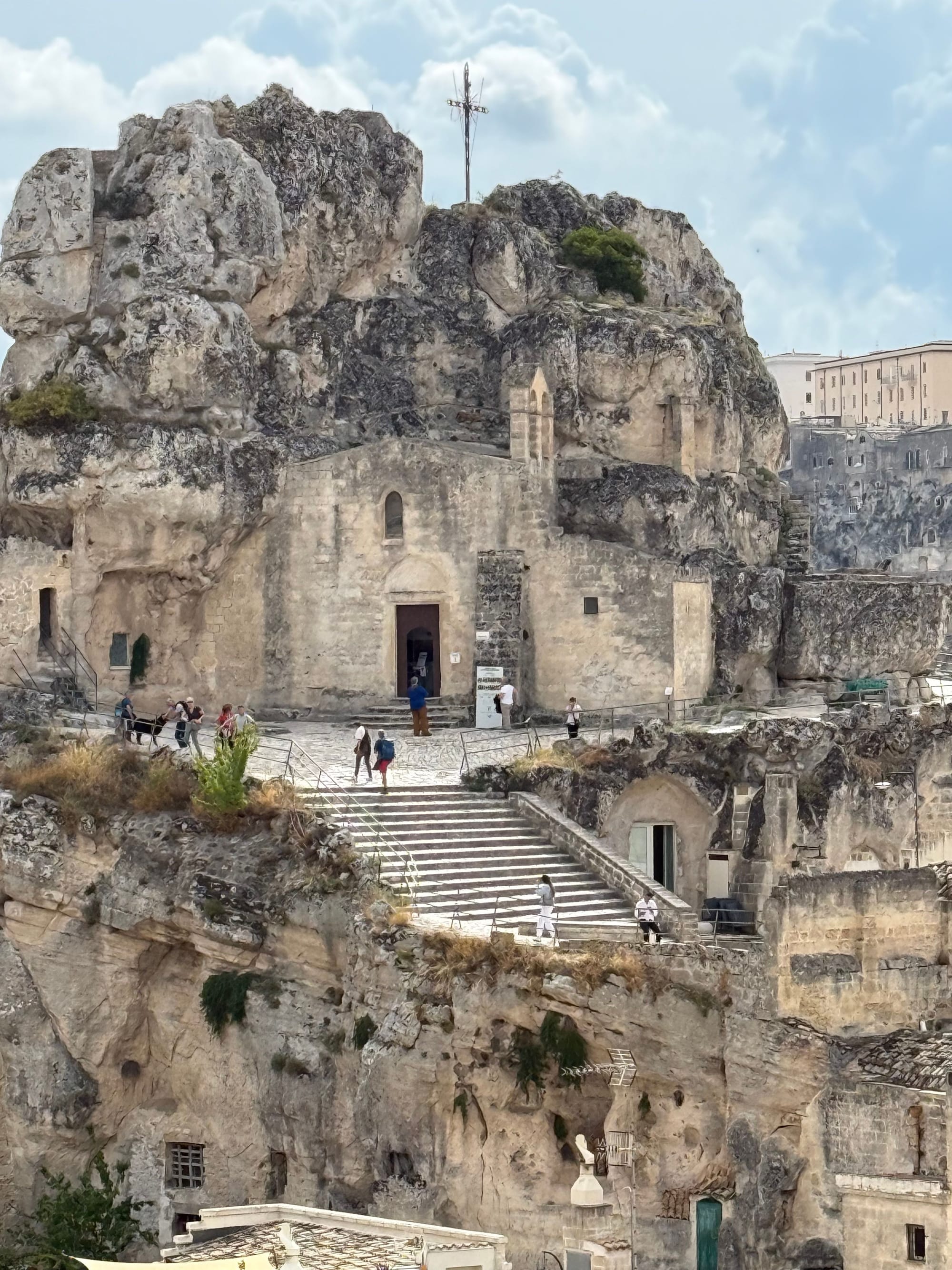
The Murgia Materana park around Matera contains more than 150 rock-hewn churches carved into the canyon walls between the early Middle Ages and the 19th century - many with frescoes in varying states of preservation. These rupestrian churches are included in Matera's UNESCO designation alongside the Sassi themselves.
Santa Maria di Idris and San Pietro Barisano in the Sassi itself are the most accessible and contain good examples of the Byzantine-influenced frescoes that characterise the tradition. Santa Maria di Idris, carved into a rock outcrop in Sasso Caveoso with views over the ravine, is particularly atmospheric.
The Crypt of the Original Sin (Cripta del Peccato Originale), about 15km outside Matera, is the most extraordinary of the rupestrian churches - an 8th-century cave church with frescoes described as some of the finest early Christian art in southern Italy, sometimes called "the Sistine Chapel of cave churches." It requires either a hire car or an organised tour from Matera.
Food and Drink in Matera
Matera's food culture is rooted in the Basilicata tradition - simple, local ingredients, strong flavours, minimal fuss.
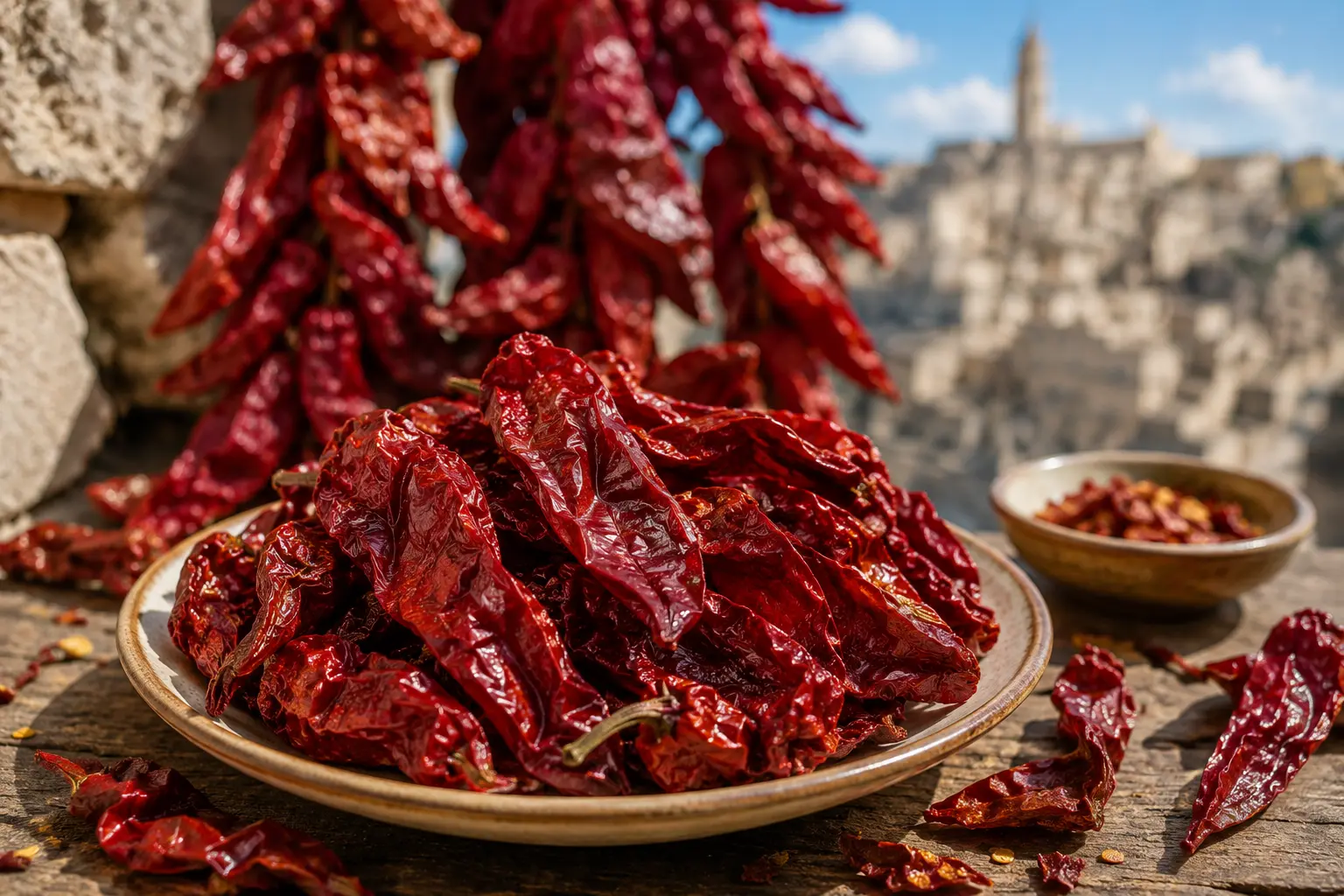
Cruschi peppers are the defining flavour of Basilicata - the Senise IGP pepper, sun-dried and then fried briefly in olive oil until crisp, served as a snack or crumbled over pasta. The taste is sweet, slightly smoky and addictive.
Pignata is the local slow-cooked meat dish - traditionally lamb or mutton, cooked for hours in a sealed terracotta pot with tomatoes, onions, potatoes and herbs in a wood-fired oven.
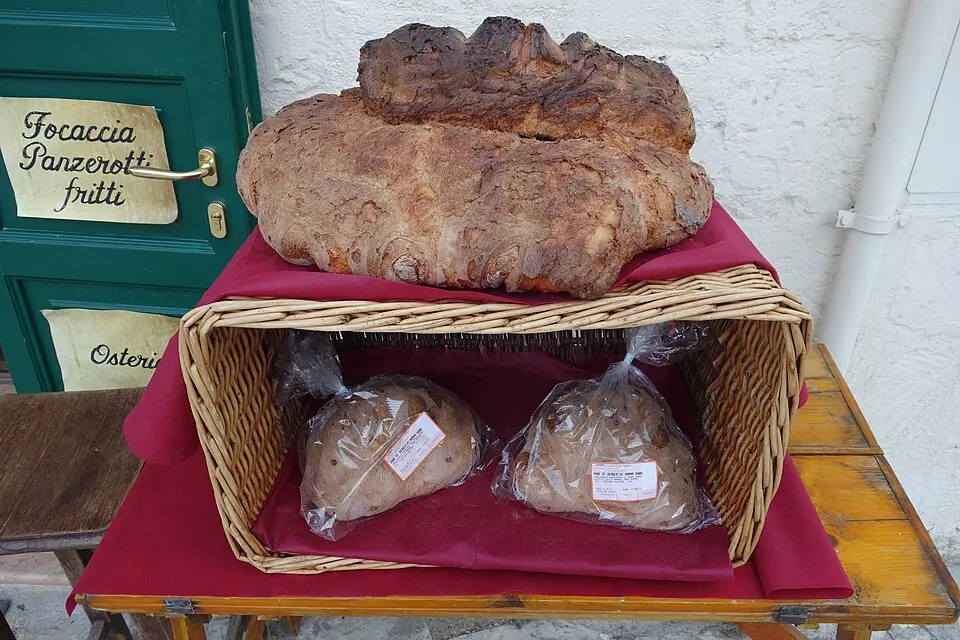
Matera bread (pane di Matera IGP) is a distinctive large loaf baked from durum wheat semolina, with a thick crust and dense, golden crumb. It lasts for days, but tastes best the morning after baking, which is why local bakeries begin production in the early hours. Buy a loaf and eat it with local cheese and cruschi peppers.
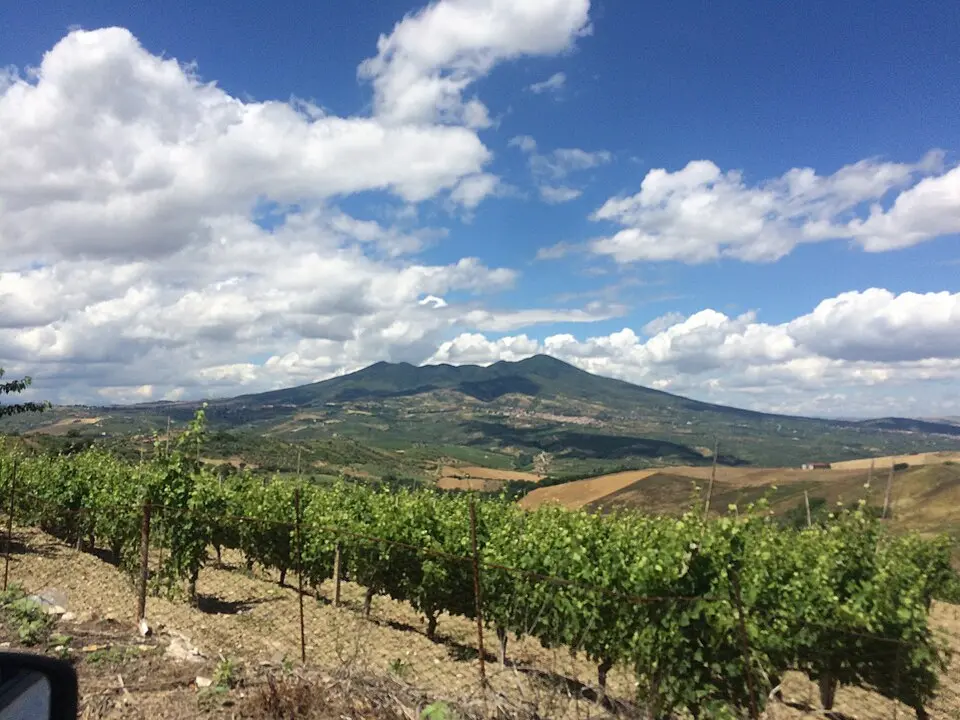
Aglianico del Vulture is the great red wine of Basilicata - produced from the Aglianico grape on the volcanic slopes of Monte Vulture, north of Matera. Full-bodied, tannic and age-worthy, it's one of the most serious wines in southern Italy and available in every good restaurant in the Sassi.
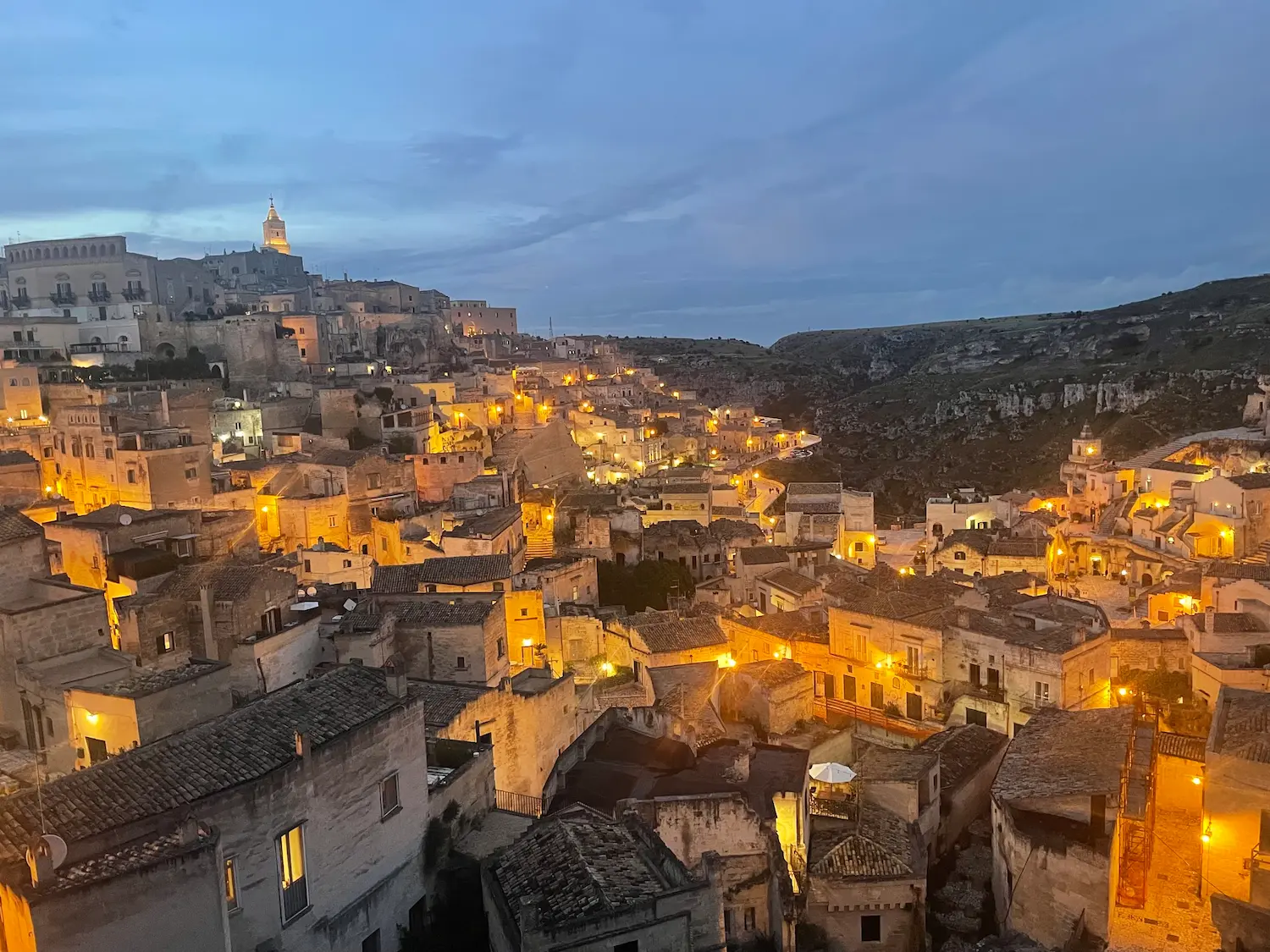
The sunset aperitivo: One of the genuinely perfect things to do in Matera is to find a bar or terrace in the Sassi with a view over the ravine, order a glass of local wine and watch the light change as the sun drops. The limestone turns from yellow to gold to ochre and the shadows deepen in the canyon below. This is the Matera experience distilled. I did exactly this on my first evening there - and it was just stunning.
Where to Stay
Stay in the Sassi. I would say that this is not negotiable. Staying in the modern city above and visiting the Sassi as a day trip would be to miss the entire point of Matera - the experience of waking up among the Sassi, walking out into the ancient lanes, hearing the silence in the early morning before anyone else is there.
Cave hotels range from genuinely luxurious (Sextantio Le Grotte della Civita, Aquatio Cave Luxury Hotel) to comfortable mid-range options and simpler B&Bs carved from the rock. However, you don't necessarily need to stay in the caves themselves, as many accommodation options are built above ground, and are just as beautiful.
A personal recommendation: Gradelle San Nicola in the heart of the Sassi - a quiet, characterful accommodation with a genuine sense of the place.
Sasso Barisano suits visitors who want more restaurant and nightlife access. Sasso Caveoso suits those who want quiet, atmosphere and the most dramatic setting.
Practical Information
How long do you need: Two nights is ideal - enough to see everything at a relaxed pace without rushing. Three nights allows you to add the Crypt of the Original Sin or a day trip to Alberobello (only an hour away), but requires a hire car or organised tour for those.
Shoes: This cannot be over-emphasised. The Sassi involves hundreds of steps, uneven tufa surfaces, steep inclines and slippery stone in wet weather. Do not attempt walking around the Sassi in flimsy sandals, flip-flops or heels.
Luggage: Getting to your cave hotel with large bags can be difficult - the lanes of the Sassi are narrow and the stairs are steep. Pack a manageable bag, arrange with your hotel to have luggage transferred, or take a taxi.
Alternatively, you could leave your main case in Rome or Naples for a couple of nights, and take a smaller bag. Or you could leave your main bag in storage in the central modern part of Matera.
Radical Storage and Bounce both have locations in Rome, Naples and Matera where you can store your luggage.
Getting around Matera: The city is compact and the Sassi are best explored on foot. The modern city above has buses, but almost everything worth seeing is walkable from the Sassi. Taxis are available from Piazza Matteotti - useful for reaching the Via Don Luigi Sturzo bus terminal.
When to visit: April to June and September to October are the best months - comfortable temperatures for walking, the best light for photography. July and August are very hot in the exposed limestone of the Sassi. Winter is quiet, atmospheric and sometimes cold - the Sassi in early morning mist is extraordinary.
Frequently Asked Questions
Can I get to Matera without a hire car?
Yes - entirely. The recommended route is train from Rome to Bari Centrale (around 4 hours 40 mins on Trenitalia), then a direct bus from Bari to Matera (around 1 hour 15 minutes), arriving at Via Don Luigi Sturzo bus terminal.
Alternatively, Ryanair and ITA fly from Rome Fiumicino to Bari, with a direct bus connection to Matera from the airport (arriving at Via Aldo Moro - next to Piazzale Matteotti). For those on a tight budget, Flixbus runs direct from Rome Tiburtina to Matera in around 6 hours 30 minutes from around €20.
How long should I spend in Matera?
Two nights is the right amount - enough to see the Sassi properly, visit the Palombaro Lungo, cross the rope bridge to the Murgia viewpoint, do a cave tour and eat well without rushing. Three nights adds flexibility for day trips or slower exploration.
What is the Palombaro Lungo?
A vast underground cistern beneath Piazza Vittorio Veneto, hand-carved from the rock over several centuries with a capacity of five million litres. It is part of the water management system that is central to Matera's UNESCO World Heritage designation. Visits are by guided tour only, around 30 to 45 minutes, entry around €3. One of the most extraordinary things to see in Matera.
What is the suspension bridge in Matera?
The Ponte Tibetano, opened in 2012, crosses the Gravina ravine from the Sassi to the Murgia Materana park on the opposite canyon wall. The crossing gives extraordinary views of the full Sassi face-on, and the Belvedere di Murgia Timone on the far side offers the most famous panoramic view of the city. Free to cross, around 30 to 45 minutes each way.
Should I stay in the Sassi?
Yes - staying in the Sassi is the defining experience of Matera and not to be missed. The atmosphere of waking up among the rocks that people lived in seventy years ago, in lanes that have been inhabited for nine thousand years, is entirely unlike any other hotel experience in Italy.
How do I get from Matera to Bari?
The buses from Via Don Luigi Sturzo bus terminal (35 mins walk from the Sassi) reach Bari in around 1 hour 15 minutes - they run regularly and are relatively inexpensive. From Bari Centrale you can take a Trenitalia train to Naples (3 hours, 30 mins) or Rome (4 hours 40 mins).
Alternatively you can catch a flight from Bari airport. In which case, you would take a Cotrap or Cotrab bus to the airport from Via Aldo Moro (next to Piazzale Matteotti).
Is Matera worth visiting?
Without question. Matera is one of the most extraordinary places in Italy - genuinely unlike anything else in the country or on the continent. The Sassi, the underground cisterns, the cave churches, the suspension bridge across the ravine, the sunset aperitivo overlooking it all - these are experiences that stay with you. Two nights is enough to see it properly. Go.
Also on The Unseen Italy: How Italy's Train Network Works · Naples — The Complete City Guide · Day Trips from Naples by Train · 10 Mistakes First-Time Italy Train Travellers Make · Alberobello by Train & Bus from Bari: A Day Trip to Puglia's Trulli Town